VAT on Loft Insulation: 0% Until 31 March 2027
Updated 29 September 2026 · Free Insulation Loft
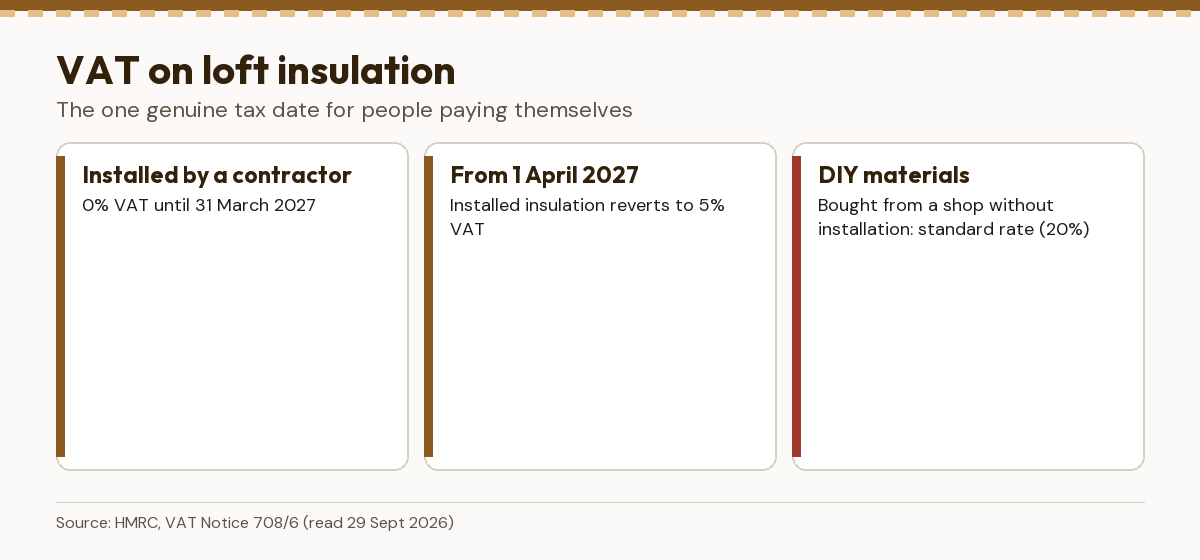
VAT on loft insulation is simple once you know the one distinction HMRC draws: whether the insulation is installed by the person who supplies it. This matters only if you are paying. If a scheme funds your loft, VAT is not your concern.
The rule
HMRC’s Notice 708/6 covers energy-saving materials, including insulation. The installation of energy-saving materials in residential accommodation is zero-rated until 31 March 2027. From 1 April 2027, the rate reverts to the reduced rate of 5%.
The relief applies to “the services of installing energy-saving materials” and to the supply of those materials by the person who installs them. HMRC is explicit about the other side: if you supply energy-saving materials without installing them, the supply is standard-rated, and the sale of energy-saving materials by a retailer is always standard-rated.
| How you get the insulation | VAT until 31 March 2027 | VAT from 1 April 2027 |
|---|---|---|
| Supplied and installed by a contractor in your home | 0% | 5% |
| Bought from a shop or online, fitted yourself | Standard rate | Standard rate |
| Funded by a scheme | Not your cost | Not your cost |
What it means for a quote
A professional quote for loft insulation in a home should not include VAT on the insulation work before 1 April 2027. If a quote adds VAT to installed insulation, ask why. After that date, expect 5% on the same work. On the Energy Saving Trust’s average of about £750 for a bare semi-detached loft, 5% would add a modest amount; it is a genuine but small difference, not a reason to rush a job you are unsure about.
DIY and VAT
Doing it yourself saves the labour, but the rolls you buy carry standard-rate VAT because no installation service is supplied. For a dry, easy-to-reach loft, DIY is usually still cheaper overall; for a larger or awkward loft, compare a professional quote before deciding. See how to insulate a loft.
Why this is the only real deadline for payers
We do not do sales countdowns. But 31 March 2027 is a real, published date that changes the cost of a paid job. It sits alongside the other dates on this site: ECO4 ending on 31 December 2026, and the Warm Homes: Local Grant running to 31 March 2028 in England. If you were going to insulate this winter anyway, the VAT date is a reason to get it done before April 2027. If you might qualify for a free scheme, check that first: who qualifies.
Related costs
For the full price table by house type, the payback maths and the Northern Ireland figures, see the loft insulation cost guide and is loft insulation worth it?.
Common VAT questions
Does the 0% rate apply to a loft conversion? HMRC’s relief is for installing energy-saving materials such as insulation. A loft conversion involves much more than insulation, and the other building work is not covered by this relief. Ask the builder to show the insulation element separately on the quote, and take advice if the VAT treatment is unclear.
What if the installer also boards the loft? Boarding is not an energy-saving material. Expect the quote to treat the insulation and the boarding separately. The insulation installed by the contractor is zero-rated until 31 March 2027; the boarding follows the normal rules.
Does it matter if the work is funded by a scheme? Not to you. Under ECO4 or a council scheme, the installer is paid through the scheme and you are not invoiced for the funded work. If you are asked to contribute to the cost, the VAT treatment of that contribution is a question for the installer; ask for it in writing.
Is it the same in Scotland, Wales and Northern Ireland? VAT is a UK-wide tax, and Notice 708/6 covers the relief for energy-saving materials. The same 0% rate and the same 31 March 2027 end date apply to installed insulation in homes.
How do I check a quote is right? Look for the insulation work shown separately, with VAT at 0% on that line until 31 March 2027. A quote that shows one lump sum “including VAT” makes it hard to tell. It is reasonable to ask for a breakdown, and the Energy Saving Trust recommends a written breakdown of costs from any installer in any case.
What about the cost of clearing the loft or removing old insulation? These are services connected to the job, and how they are treated can depend on how the work is supplied. Ask the installer to explain the VAT on each line, and keep the invoice.
Using the VAT date sensibly
If you already know you will pay for a bare or thin loft, the 0% rate is a small bonus on a job with a strong payback anyway: on Energy Saving Trust figures a bare loft pays back in roughly three to five years. If you are weighing a top-up from 120mm, where the EST puts the saving at £13 to £35 a year, the VAT date should not be the deciding factor. And if you may qualify for ECO4 or a council scheme, find that out first, because a funded job costs you nothing either side of April 2027.
Source: HMRC, VAT on energy-saving materials and heating equipment (Notice 708/6), read 29 September 2026. Energy Saving Trust, roof and loft insulation, updated 8 May 2026.