Eligibility
Who qualifies for free loft insulation in 2026
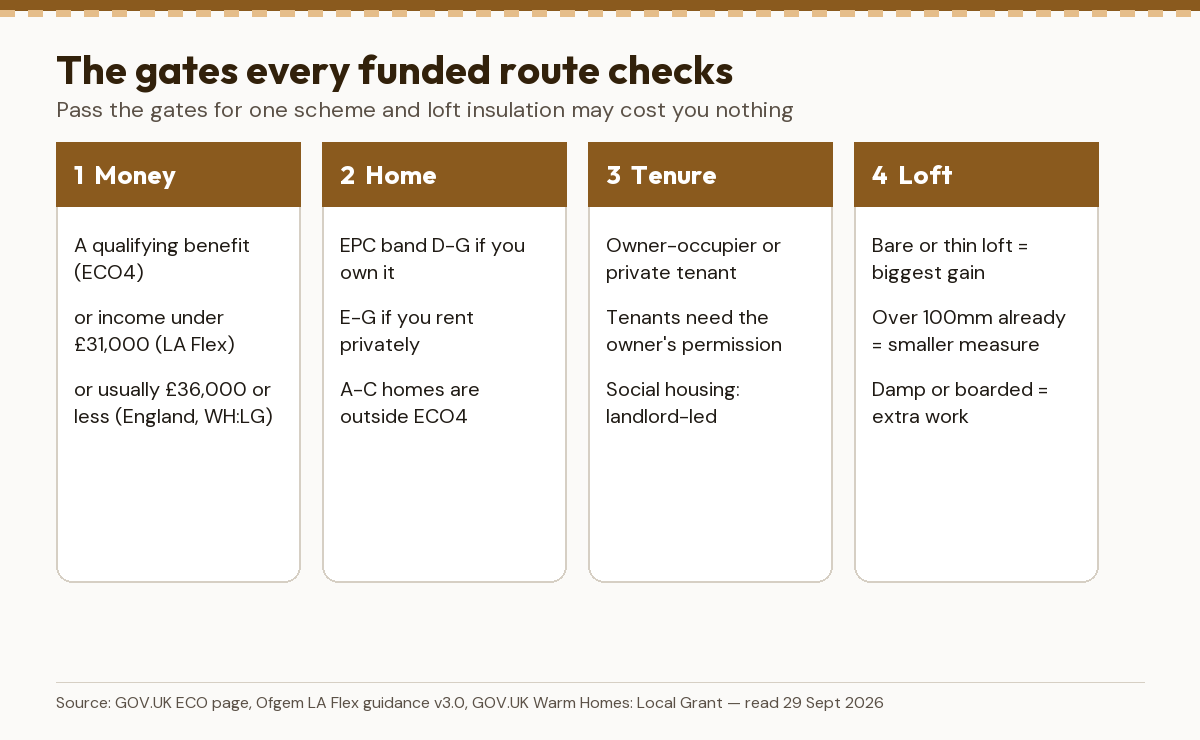
Written for homeowners and private tenants in England, Scotland, Wales and Northern Ireland who want a straight answer before handing their details to anyone. Four gates decide it: money, the home's EPC band, tenure, and what is already in the loft.
Which route fits your home? A one-minute check
Five questions, no contact details. The result shows the routes your answers point to; the scheme, council or supplier makes the real decision.
Your indicative result
Indicative only, based on the published rules we read on 29 September 2026. Nothing is sent anywhere. Check your EPC band on the GOV.UK register before you apply.
Gate one: money
Every funded route is aimed at lower-income households, but they measure it differently. It helps to know which measure applies to you before you start, because an installer’s form will usually ask only one question and stop there.
A qualifying benefit. ECO4’s standard route (sometimes called Help to Heat) starts with the benefit list on GOV.UK. For private housing it is Universal Credit, Pension Guarantee Credit, Pension Savings Credit, Income Support, income-based Jobseeker’s Allowance, income-related Employment and Support Allowance, Child Benefit and Housing Benefit. The person claiming must live in the home; if that is not you, say so when you apply.
Household income under £31,000. Ofgem’s LA Flex guidance (version 3.0, March 2026) lets a council refer a household whose combined gross annual income is under £31,000. It counts every adult aged 18 or over who lives there permanently, including lodgers and older relatives, and the cap is the same whatever the size of the home, the size of the household or the region. Overtime and interest count.
Other LA Flex routes. A council can also refer a household that meets two of seven “proxies” (for example living in a deprived area, receiving a low-income council tax reduction, or having a child on free school meals), or through a medical referral for someone whose health is made worse by a cold home.
England’s Warm Homes: Local Grant. GOV.UK says household income must usually be £36,000 a year or less, or you may qualify through your postcode or certain benefits. This is a separate scheme from ECO4 with its own gates; the two figures are often mixed up.
The nations. Scotland, Wales and Northern Ireland each run their own tests: passport benefits for Warmer Homes Scotland, income after housing costs for Nest in Wales (for example under £15,521 for a single adult with no children), and gross household income under £23,000 for Northern Ireland’s Affordable Warmth Scheme.
Gate two: the home’s EPC band
Schemes fund homes that waste the most energy, and they use the Energy Performance Certificate to decide. Look your home up on GOV.UK’s “find an energy certificate” service; it takes a postcode and a minute.
| Who you are | ECO4 | Warm Homes: Local Grant (England) | Nest (Wales) |
|---|---|---|---|
| Owner-occupier | D, E, F or G | D to G | Score 54 (E) or lower; 68 (D) with a health condition |
| Private tenant | E, F or G, with the owner’s permission | D to G (privately rented homes can qualify) | As above |
| Social tenant | E, F or G, landlord-led | Not the route | Not eligible |
A home rated A, B or C is outside ECO4 and the Warm Homes: Local Grant. If you have no certificate, the retrofit assessment at the start of a funded job will produce a rating; the outcome can change your eligibility, which Ofgem tells councils to explain to residents up front.
Gate three: tenure
Owners apply on their own circumstances. Private tenants can apply too, but the work needs the owner’s permission, and ECO4 wants band E or below for rented homes. Social housing tenants do not apply for loft insulation themselves: the council or housing association decides. Landlords with more than one property should read tenants and landlords, because for rented homes it is the tenant’s circumstances, not the landlord’s, that the benefit and income tests look at.
Gate four: what is already in the loft
This is the gate people forget. Ofgem’s ECO4 delivery guidance has two separate loft measures: one where there is 100mm or less of existing insulation, and one where there is more than 100mm. The first is the job schemes are designed for. The second counts for far less, because the saving is small. The Energy Saving Trust puts a top-up from 120mm to 270mm at an extra £17 or so a year for a semi-detached house, against about £190 for insulating a bare loft.
Before anything is installed under ECO4, the installer and the occupier (or landlord) sign a declaration of what is already in the loft, and a copy is left near the hatch. It is worth measuring the depth yourself first. A tape measure pushed down to the ceiling plasterboard in three or four places gives you the answer; see loft insulation depth.
Lofts that are boarded, damp, used as a room or built as a flat roof need more than a roll of mineral wool. They can still be funded, but expect a longer assessment and a different measure. Warm roof vs cold roof explains the options.
Putting the gates together
Here is how the gates combine in practice. These are not real households; they show how the rules interact.
- A homeowner on Pension Credit in an EPC D bungalow with 50mm in the loft: passes ECO4’s benefit, EPC and loft gates.
- A couple earning £29,000 between them, no benefits, EPC E semi: not on the benefit route, but a council LA Flex referral fits if their council takes part.
- A family earning £34,000, EPC D, England: above the LA Flex cap, but within the Warm Homes: Local Grant’s usual income line.
- A homeowner earning £45,000, EPC E, Scotland: no benefit route, but eligible to apply for a Home Energy Scotland loft grant of up to £1,500.
- A tenant in a band C flat: outside ECO4. The honest answer is to talk to the landlord, or to accept that no scheme will fund it.
If none of these fit, the next question is simply cost. The loft insulation cost guide has the Energy Saving Trust prices by house type and an estimator, and is loft insulation worth it? runs the payback.
What to have ready when you apply
Whichever door you use, the same few documents come up: proof of the benefit (an award letter or a screenshot of your Universal Credit journal), payslips or a pension statement if you are going through LA Flex on income, your EPC or the address so it can be found, and your landlord’s written permission if you rent. Keep copies. If a firm asks for bank details or a fee to “reserve a grant”, stop and read our page on loft insulation myths and scams.
Before you decide
I own my home but my EPC is band C. Is there any way in?
Not through ECO4 or the Warm Homes: Local Grant: both start at band D for owners. In Scotland the Home Energy Scotland Grant and Loan does not use the same EPC gate, and anyone can insulate a loft themselves. If your EPC is old, a new assessment may give a different band, but do not pay for one on the promise of a grant.
My income is just over £31,000. Am I out?
Out of LA Flex Route 1, yes. Route 2 (two proxies such as a low-income council tax reduction or a deprived area) and Route 3 (a health condition made worse by the cold) do not use the income figure. In England, the Warm Homes: Local Grant usually allows up to £36,000.
Does my council have to take part?
For LA Flex and the Warm Homes: Local Grant, yes. Councils publish an LA Flex statement of intent if they refer households for ECO4, and GOV.UK's online checker tells you whether your council is delivering the Warm Homes: Local Grant.
Will checking my eligibility commit me to anything?
No. The checker on this page runs in your browser and sends nothing. If you later ask for quotes, you can stop at any point.
Questions people ask
Which benefits qualify for free loft insulation?
For ECO4 in private housing, GOV.UK lists Universal Credit, Pension Guarantee Credit, Pension Savings Credit, Income Support, income-based Jobseeker's Allowance, income-related Employment and Support Allowance, Child Benefit and Housing Benefit. The home must also be in the right EPC band.
Can I get free loft insulation without benefits?
Yes, through ECO4 LA Flex if your council refers you (for example combined gross household income under £31,000), through England's Warm Homes: Local Grant (income usually £36,000 or less), or with a Home Energy Scotland loft grant of up to £1,500 that has no benefit test.
Do pensioners automatically qualify?
No. Age alone is not a gate for ECO4. Pension Credit (Guarantee or Savings Credit) is a qualifying benefit, and in Scotland Warmer Homes Scotland covers households with someone aged 75 or over who has no working heating.
What EPC rating do I need for free loft insulation?
For ECO4, D, E, F or G if you own the home; E, F or G if you rent privately or from a social landlord. The Warm Homes: Local Grant needs D to G. Nest in Wales uses an EPC score of 54 (band E) or lower, or 68 (band D) with an eligible health condition.
Does the Great British Insulation Scheme still qualify households by council tax band?
No. The Great British Insulation Scheme ended on 31 March 2026, so its council tax band route no longer exists.
Sources we checked
- GOV.UK, Help from your energy supplier: the Energy Company Obligation — read 29 September 2026
- Ofgem, ECO4 and GBIS Flex Local Authority Guidance v3.0 (27 March 2026) — read 29 September 2026
- Ofgem, ECO: homeowners and tenants — read 29 September 2026
- GOV.UK, Apply for the Warm Homes: Local Grant to improve a home — read 29 September 2026
- Home Energy Scotland, Warmer Homes Scotland — read 29 September 2026
- Home Energy Scotland, Grant and Loan — read 29 September 2026
- Welsh Government, Nest: eligibility for free home energy efficiency improvements — read 29 September 2026
- Northern Ireland Housing Executive, Affordable Warmth Scheme — read 29 September 2026
- GOV.UK, Great British Insulation Scheme (closure notice) — read 29 September 2026
- GOV.UK, Find an energy certificate — read 29 September 2026
Ask for loft insulation quotes or a second opinion
Tell us a little about your situation. We pass your enquiry to relevant independent firms covering your postcode; they contact you directly. There is no charge to you for this.
What happens next
- We read your enquiry and check which kind of firm can help.
- We pass it to relevant independent firms that cover your postcode.
- They contact you with questions or a quote. You compare, and decide — with no obligation to go ahead.