Ventilation
Loft ventilation and condensation after insulating
For anyone about to insulate a loft, or who has noticed damp since they did. Good insulation keeps heat downstairs, which makes the loft colder, and a colder loft handles moisture differently. None of this is a reason not to insulate. It is a reason to insulate properly.
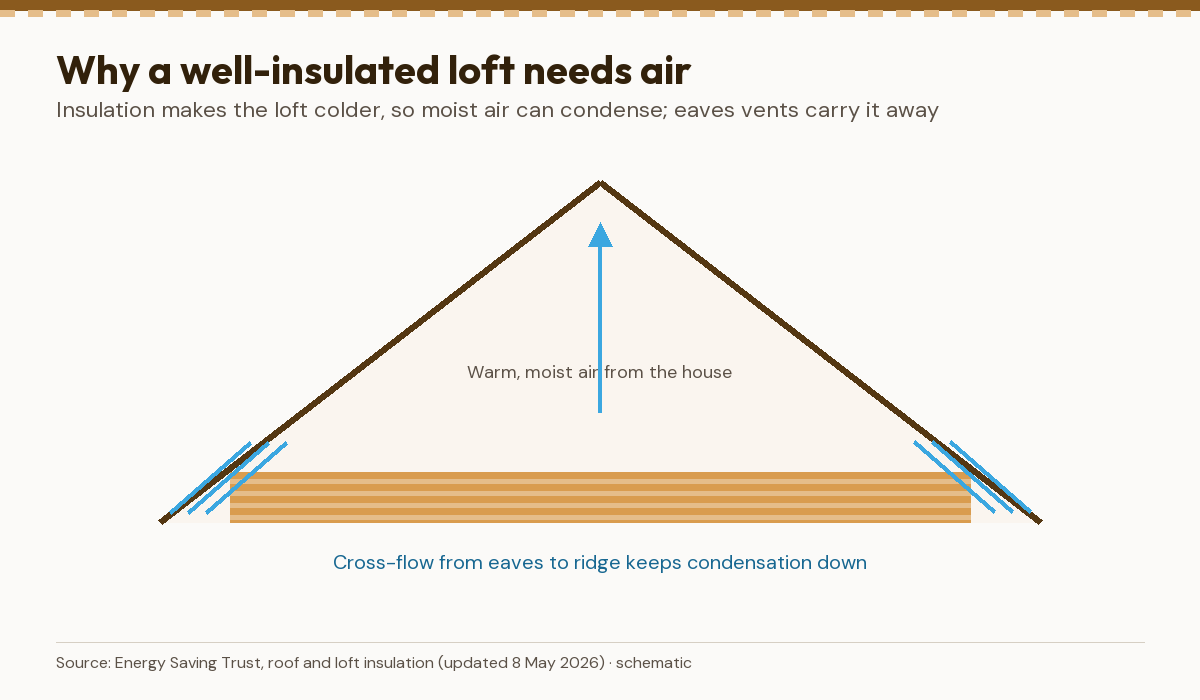
Why a well-insulated loft gets colder
Before insulation, heat leaking up from the house keeps the loft relatively warm. Put 270mm of mineral wool on the loft floor and most of that heat stays in the rooms below, which is the point. The loft space above the insulation is now close to outdoor temperature. The Energy Saving Trust (EST) puts it plainly: insulation slows heat escaping from living spaces, making the loft cooler, which makes condensation more likely or can worsen existing damp.
Moisture reaches the loft in warm air from the house: through gaps around the hatch, light fittings and pipes, and sometimes from fans that vent into the roof space rather than outside. When that air meets cold roof timbers or felt, it condenses.
The three things that keep a loft dry
1. Air moving through the roof space. In most pitched roofs, air enters at the eaves (the low edges of the roof) and leaves higher up. Insulation must stop short of the eaves so it does not block this. Some roofs also have tile or ridge vents.
2. Less moist air getting in from below. Draught-strip the loft hatch, seal gaps where pipes and cables pass through the ceiling, and make sure bathroom and kitchen extractor fans are ducted outside, not into the loft.
3. No water getting in from above. A leaking roof has to be fixed before insulating. The EST warns against any firm offering to “fix” a leaking roof with spray foam instead of repairing it.
| Symptom in the loft | Likely cause | What to do |
|---|---|---|
| Damp or stained insulation near the eaves | Insulation packed into the eaves; rain entry | Pull insulation back; check the roof edge |
| Droplets or frost on the underside of the felt | Moist air from the house, poor ventilation | Seal gaps below; clear the eaves; check fans |
| Black spots on timbers | Long-running condensation | Find and fix the moisture source; get advice |
| One wet patch | A leak | Repair the roof, then dry and replace the insulation |
Ventilation in funded jobs
ECO4 and Warm Homes: Local Grant work is delivered under the PAS 2035 retrofit process, which starts with an assessment of the whole home. Whatever route you use, the EST’s list of questions for installers includes whether they will assess and address ventilation needs as part of the job. Ask it, and check the loft afterwards.
Boards, storage and the air gap
If you store things in the loft on a raised platform, the EST says to leave a small gap for ventilation between the insulation and the boards to prevent condensation. Boards pressed down onto insulation remove that gap and squash the insulation at the same time. See loft boarding and insulation.
Roof-level insulation and spray foam
The risk is higher when insulation goes against the roof itself. The EST describes spraying vapour-impermeable foam directly onto the underside of an old, poorly maintained roof as one of the highest-risk insulation options, because moisture from leaks or condensation can be trapped against the timbers. Rafter-level insulation done properly includes ventilation and vapour control in the design. See warm roof vs cold roof and spray foam problems.
Not a real home. A family notice droplets on the underside of the roof felt in the first winter after insulating. The loft has 270mm of mineral wool, but the installer pushed it right into the eaves, and the bathroom fan’s duct ends loose in the loft. Pulling the insulation back from the eaves and extending the fan duct to an outside vent stops the condensation, without removing any insulation.
After the job: a five-minute check
Look in the loft on a cold morning in the first winter. You want dry insulation, clear eaves, no droplets on the felt, fans ducted outside, and pipes and tanks lagged. If anything looks wrong, go back to the installer first: under a funded scheme, GOV.UK says to contact the installer or the company that guaranteed the work, and then Citizens Advice if the problem is not solved.
Before you decide
Will insulating my loft cause damp?
Not if it is done properly. The Energy Saving Trust notes that insulation makes the loft cooler, so condensation becomes more likely, which is why ventilation and fixing any existing damp first are part of the job.
I have black spots on the roof timbers since the loft was insulated.
That suggests condensation or a leak. Check whether the eaves are blocked, whether bathroom or kitchen fans vent into the loft, and whether the roof is letting water in. Get professional advice if it persists.
Should I buy a dehumidifier for the loft?
Treat the cause first: blocked eaves, air leaking up from the house, fans venting into the loft or a roof leak. A dehumidifier treats the symptom.
Questions people ask
Does a loft need ventilation after insulating?
Yes. Insulating the loft floor makes the loft colder, which makes condensation more likely, so air needs to move through the roof space, usually in at the eaves.
Can loft insulation cause condensation?
It can make condensation more likely because the loft is colder. The Energy Saving Trust says to think about ventilation when insulating, and to fix any damp first.
Why should the eaves be left clear?
The eaves are where air enters the roof space in most pitched roofs. Packing insulation into them blocks that air flow.
What causes a damp loft?
Most often a roof leak, moist air rising from the house through gaps, bathroom or kitchen fans venting into the loft, or blocked ventilation.
Sources we checked
- Energy Saving Trust, Roof and loft insulation (last updated 8 May 2026) — read 29 September 2026
- Energy Saving Trust, Spray foam insulation: get the facts (last updated 5 December 2024) — read 29 September 2026
Ask for loft insulation quotes or a second opinion
Tell us a little about your situation. We pass your enquiry to relevant independent firms covering your postcode; they contact you directly. There is no charge to you for this.
What happens next
- We read your enquiry and check which kind of firm can help.
- We pass it to relevant independent firms that cover your postcode.
- They contact you with questions or a quote. You compare, and decide — with no obligation to go ahead.