Spray foam
Spray foam insulation in the loft: problems and removal
For homeowners who have been offered spray foam, already have it, or are trying to sell a house with it. Spray foam is not always a disaster, but it is one of the riskiest ways to insulate a loft, and it is sold with some claims the Energy Saving Trust calls out as misinformation.
What spray foam is
The Energy Saving Trust (EST) describes spray foam insulation as a liquid polyurethane foam that installers apply with a spray gun; it sets to form an insulating layer. Because it is sprayed, it can reach awkward areas quickly. It is used on roofs, walls and floors, and in a loft it is usually sprayed onto the underside of the sloping roof, instead of laying mineral wool on the loft floor.
There are two main types, and the difference matters:
| Type | How it behaves | The trade-off |
|---|---|---|
| Closed-cell | Sets solid; one of the most effective insulation materials used in homes; can add some structural support | Not vapour permeable: moisture in the air or the timbers cannot escape through it |
| Open-cell | Lighter and more flexible; more vapour permeable | A less effective insulator, so a thicker layer is needed |
The problems, according to the Energy Saving Trust
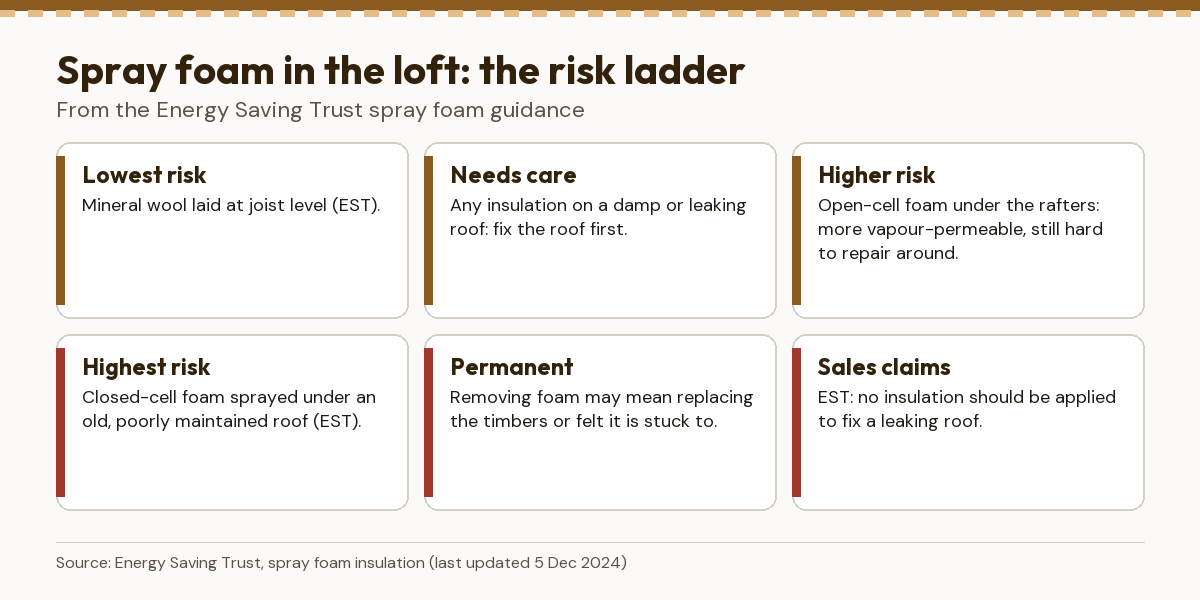
Timber rot. Spraying foam directly onto the underside of the roof partly seals the timber. If rainwater from a leak collects there, it will eventually cause the timbers to rot. Even without a leak there is a risk of condensation doing the same. The EST says this risk should be much lower with open-cell foam.
Repairs. Timbers coated in foam are harder to replace. So are tiles or slates, if there is no roofing felt or other layer between them and the foam.
Permanence. Spray foam is considered a permanent installation. If you decide to remove it later, you may also need to replace the structure it was applied to.
False claims. The EST records two sales lines it treats as problems in themselves: that foam will fix a leaking roof (no insulation should go onto a leaking roof), and that existing mineral wool no longer complies with regulations and must be replaced (misinformation used to increase sales).
Mortgages and selling
The headline worry for many owners is selling. The EST’s view is that mortgage refusals were possibly true for a while, when lenders reacted to concerns about damp and repairability, but that progress in assessing whether a house is at risk means there should be less of an issue for homes where spray foam was installed correctly. In practice, a buyer’s surveyor may ask to see the loft and any paperwork. Keep the installer’s details, the product used and any guarantee together.
Removal: when and how
Removal is not automatically the answer. Start with an independent look at the roof:
- Is the roof dry? Check for leaks, damp patches, staining or a musty smell. Any leak must be repaired regardless.
- What type of foam is it? Closed-cell foam carries the higher moisture risk.
- What condition are the timbers in? A surveyor can check for decay where the foam allows.
- What will replace it? Once foam is removed, the loft needs insulating properly, usually with mineral wool at joist level, with the eaves ventilated.
If removal is recommended, get more than one quote, make sure each one covers repairs to timbers or felt that removal may reveal, and ask how the loft will be insulated afterwards. The EST suggests getting multiple quotes from accredited installers, such as TrustMark-registered businesses.
Not a real home. The owners of a 1950s semi were told their 150mm of mineral wool “no longer complied” and were quoted for closed-cell foam on the rafters. On the EST’s guidance, the claim is misinformation, and the roof, with original felt and some slipped tiles, is exactly where foam is riskiest. Topping the existing layer up to 270mm at joist level would cost around the EST’s £600 top-up average, carries far less risk, and keeps the roof repairable.
The lower-risk alternative
For a normal pitched roof with an accessible loft, the EST describes mineral wool at joist level as one of the lowest-risk options for insulating the loft. It keeps the roof timbers ventilated and inspectable, can be laid by a competent DIYer in a dry loft, and is the method behind the EST’s own cost and saving figures. See loft insulation depth for how it is laid and warm roof vs cold roof if you need the loft space warm.
Before you decide
A salesman said my mineral wool no longer meets regulations and must be replaced with foam.
The Energy Saving Trust lists exactly this claim as misinformation some installers have used to increase sales. It says mineral wool at joist level is one of the lowest-risk ways to insulate a loft.
They said spray foam would fix my leaking roof.
The Energy Saving Trust is blunt: no insulation system should be applied to a leaking roof. Fix the roof first.
Can I get a mortgage on a house with spray foam?
The Energy Saving Trust says mortgage problems were possibly true for a while, but industry progress in assessing risk means there should be less of an issue for homes where spray foam was installed correctly. Expect lenders and surveyors to ask questions, and keep any paperwork about the installation.
Should I remove my spray foam?
Not automatically. The EST notes that removal may mean replacing the structure the foam is stuck to. Get the roof surveyed first: if timbers are dry and sound, the case for removal is weaker; if there is damp or decay, it is stronger.
Questions people ask
What are the problems with spray foam loft insulation?
The Energy Saving Trust describes three: foam sprayed onto roof timbers can trap moisture from leaks or condensation and cause rot; timbers and tiles coated in foam are harder to repair; and foam is effectively permanent, so removal may mean replacing parts of the roof.
What is the difference between open-cell and closed-cell spray foam?
Closed-cell foam sets hard and insulates very well but is not vapour permeable, so moisture cannot escape through it. Open-cell foam is lighter and more vapour permeable but a less effective insulator, so it needs a thicker layer.
Is spray foam ever the right choice?
It can be used in awkward spaces, walls and suspended floors. For a normal pitched loft where you can insulate at joist level, the Energy Saving Trust describes mineral wool at joist level as one of the lowest-risk options.
How much does spray foam removal cost?
We have not found an independent published figure we would stand behind. Costs depend on the foam type, the roof's condition and whether timbers or felt must be replaced, so get a survey and several itemised quotes.
Sources we checked
- Energy Saving Trust, Spray foam insulation: get the facts (last updated 5 December 2024) — read 29 September 2026
- Energy Saving Trust, Roof and loft insulation (last updated 8 May 2026) — read 29 September 2026
- TrustMark, find a registered business — read 29 September 2026
Ask for loft insulation quotes or a second opinion
Tell us a little about your situation. We pass your enquiry to relevant independent firms covering your postcode; they contact you directly. There is no charge to you for this.
What happens next
- We read your enquiry and check which kind of firm can help.
- We pass it to relevant independent firms that cover your postcode.
- They contact you with questions or a quote. You compare, and decide — with no obligation to go ahead.