DIY
How to insulate a loft yourself
For homeowners who do not qualify for a free scheme and have a dry, easy-to-reach loft. Loft insulation is one of the few energy-saving jobs the Energy Saving Trust says many people can do themselves, as long as the loft meets a few conditions.
First: is your loft a DIY loft?
The Energy Saving Trust (EST) says you can insulate a loft yourself only if it is:
- easy to access,
- free of damp problems, and
- not a flat roof.
It adds that if you want insulation at the sloping roof, use the loft as a living space, or have concerns about damp or structural issues, you should use a professional. If damp is present, the cause must be fixed first: insulation makes the loft colder, which makes condensation more likely and can worsen an existing problem.
What you need
- Mineral wool rolls: enough for a first layer between the joists and a second layer across them, to 270mm in total. The roll width should match your joist spacing for the first layer.
- A ruler or tape to measure the joist spacing, the existing depth and the loft floor area.
- A board or crawl board to kneel on, and a good light.
- The protective clothing, gloves and mask the product’s packaging recommends.
- A long-bladed knife or saw for cutting rolls.
- Pipe lagging and a tank jacket if there is a cold water tank or pipework up there.
| Material (EST list) | Typical use in a loft |
|---|---|
| Mineral wool / fibreglass rolls | Loft floor, between and over joists: the standard DIY choice |
| Foam boards | Rafters and tight spaces; professional work at rafter level |
| Natural fibres (cork, wood) | Alternatives to mineral wool; check the depth needed |
The job, step by step
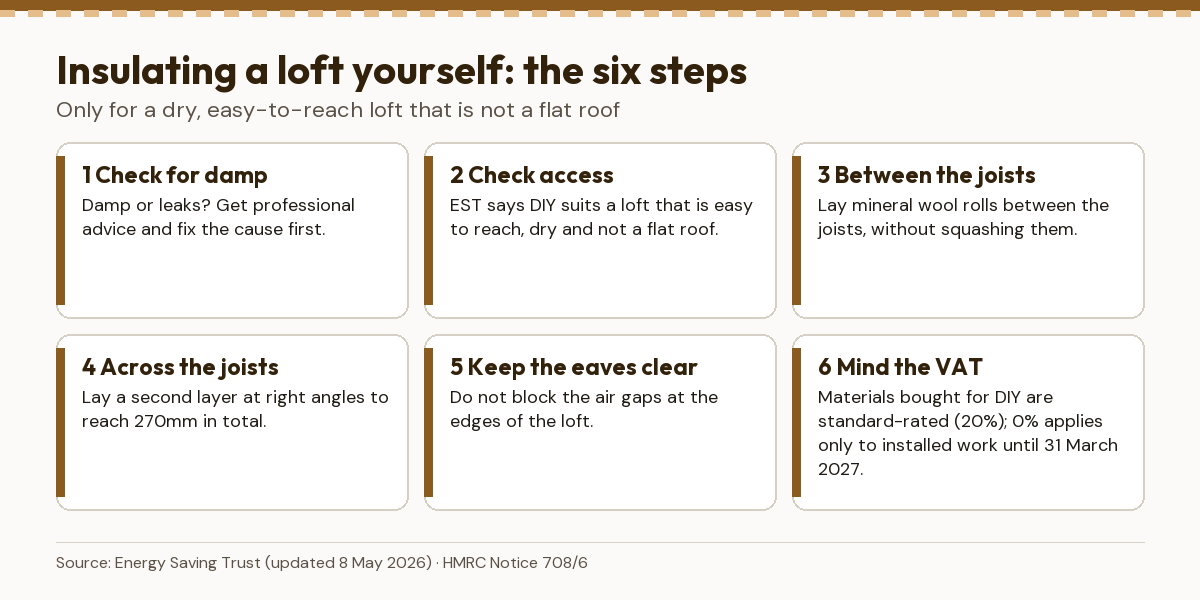
1. Clear and inspect. Move stored items out of the area you are insulating. Look for damp, staining, daylight through the roof, damaged timber and old or unsafe wiring. Stop if you find any of them.
2. Measure what is there. If there is existing insulation that is dry and clean, it can stay; the new layer goes on top. See loft insulation depth.
3. Lay the first layer between the joists. Unroll mineral wool into the gaps between the joists, pressing it gently into place without squashing it. If there is already insulation between the joists, skip to step four.
4. Lay the second layer across the joists. Run the second layer at right angles to the first, covering the tops of the joists, until the total reaches about 270mm. Butt the rolls together without gaps.
5. Keep the eaves clear. Stop the insulation short of the eaves so air can still enter at the edges of the roof. Blocking them traps moisture; see loft ventilation.
6. Deal with the cold spots. Lag pipes and insulate the top and sides of any cold water tank, but not underneath it, where warmth from below keeps it from freezing. Insulate and draught-strip the loft hatch.
7. Keep storage off it. Do not put boxes back on the insulation. If you need storage, build a raised platform; see loft boarding and insulation.
Mistakes to avoid
- Squashing the insulation. The EST warns that compressing mineral wool reduces its effectiveness.
- Blocking ventilation. Stuffing insulation into the eaves stops the air flow that keeps the roof dry.
- Covering a damp problem. Fix leaks and damp first, always.
- Covering recessed lights and cables carelessly. Leave clearance around light fittings that produce heat, as the manufacturer specifies, and do not bury cables you are unsure about.
- Spray foam as a shortcut. The EST describes foam sprayed under an old roof as one of the highest-risk options. Read spray foam problems first.
What it costs, and the VAT point
DIY vs professional. HMRC’s Notice 708/6 zero-rates insulation installed by a contractor in a home until 31 March 2027 (then 5%), but a retailer’s sale of materials without installation is standard-rated. So a DIY job saves the labour and pays full VAT on the rolls. For comparison, the Energy Saving Trust puts professional installation for a bare loft at about £650 (mid-terrace) to £1,200 (detached bungalow) in Great Britain. Get a quote before you decide.
Not a real home. The owners of a mid-terrace with a bare, dry loft and a hatch on the landing check the free routes and find they do not qualify. A professional quote comes in close to the EST’s £650. They buy mineral wool rolls, spend a Saturday laying two crossed layers to 270mm, lag the tank and pipes and draught-strip the hatch. On the EST figures the saving is about £140 a year, for the price of the materials.
Before you buy anything
Check the free routes first. If your household is on a qualifying benefit or a modest income and the home is rated EPC D or below, a scheme may do the job for nothing: who qualifies for free loft insulation has a one-minute checker.
Before you decide
Is it really safe to do myself?
In a dry, accessible loft with regular joists, the Energy Saving Trust says yes. Stay on the joists or boards, never the ceiling between them, use a good light, and wear the protection the product packaging recommends.
Is DIY cheaper than a professional once VAT is included?
Usually, because you save the labour. But installed insulation is zero-rated for VAT until 31 March 2027, while DIY materials are standard-rated, so compare a quote before assuming.
Will doing it myself stop me getting a grant later?
It removes the need. Schemes fund lofts with little insulation; once yours is at 270mm there is nothing left to fund. Check the free routes first.
Questions people ask
Can I insulate my loft myself?
Yes, if the loft is easy to access, free of damp and not a flat roof, according to the Energy Saving Trust. Sloping-roof, flat-roof and damp lofts need a professional.
What is the cheapest way to insulate a loft?
Checking whether a scheme will pay, first. If not, laying mineral wool rolls yourself in a dry, accessible loft costs only the materials, although DIY materials carry standard-rate VAT.
Which way do you lay loft insulation?
The first layer goes between the joists; the second goes at right angles across them to cover the joists and reach the required depth.
What types of loft insulation are there?
The Energy Saving Trust lists fibreglass, mineral wool, foam boards and natural fibres such as cork or wood. Mineral wool rolls are the usual choice for a loft floor; other materials need different depths.
Sources we checked
- Energy Saving Trust, Roof and loft insulation (last updated 8 May 2026) — read 29 September 2026
- HMRC, VAT on energy-saving materials and heating equipment (Notice 708/6) — read 29 September 2026
- Energy Saving Trust, Spray foam insulation: get the facts (last updated 5 December 2024) — read 29 September 2026
Ask for loft insulation quotes or a second opinion
Tell us a little about your situation. We pass your enquiry to relevant independent firms covering your postcode; they contact you directly. There is no charge to you for this.
What happens next
- We read your enquiry and check which kind of firm can help.
- We pass it to relevant independent firms that cover your postcode.
- They contact you with questions or a quote. You compare, and decide — with no obligation to go ahead.