Payback
Is loft insulation worth it?
For anyone weighing the cost against the saving, whether or not a scheme will pay. The honest answer is yes for a bare or thin loft, and only slowly for a top-up. Here is the arithmetic, using the Energy Saving Trust's own figures.
Loft insulation cost and payback estimator
Uses the Energy Saving Trust's published figures (updated 8 May 2026; Great Britain fuel prices July 2026, Northern Ireland November 2025). Unsubsidised professional installation; real quotes vary.
Your indicative result
Simple payback = installed cost divided by the annual bill saving (our arithmetic on the EST figures). If you qualify for a funded scheme your cost may be nothing: check who qualifies.
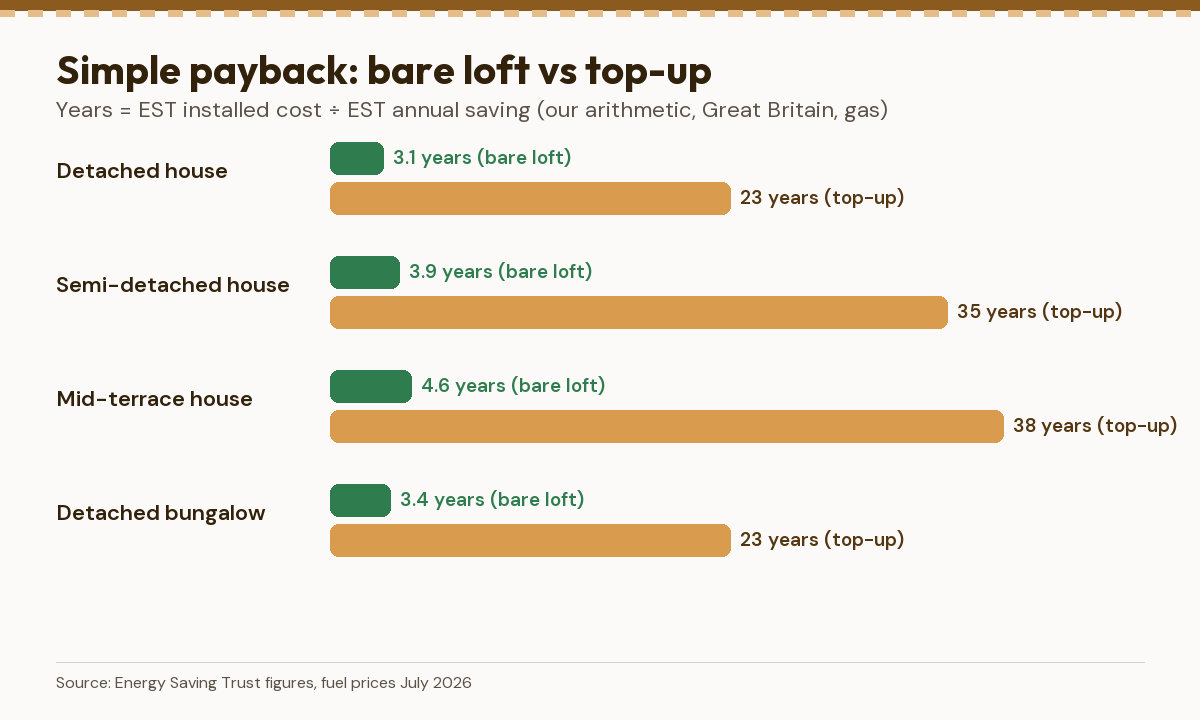
The payback table
Simple payback is the installed cost divided by the annual saving. It ignores price changes and interest, but it is the clearest way to compare. These are our calculations on the Energy Saving Trust’s published Great Britain figures (updated 8 May 2026; fuel prices July 2026; gas-heated homes; unsubsidised installation).
| Home | Bare loft: cost / saving | Payback | Top-up 120-270mm: cost / saving | Payback |
|---|---|---|---|---|
| Detached house | £1,100 / £360 | 3.1 years | £800 / £35 | 23 years |
| Detached bungalow | £1,200 / £350 | 3.4 years | £800 / £35 | 23 years |
| Semi-detached house | £750 / £190 | 3.9 years | £600 / £17 | 35 years |
| Mid-terrace house | £650 / £140 | 4.6 years | £500 / £13 | 38 years |
Set against the EST’s estimate that loft insulation lasts around 40 years, a bare-loft job pays for itself many times over. A top-up only just pays back within the insulation’s life for semis and mid-terraces.
A purchase that pays you back. Money spent on a bare loft is not like money spent on a new kitchen. On the EST figures a semi-detached house recovers the £750 in about four years, then keeps the saving, around £190 a year at today’s prices, for decades. Without it, that heat, and the money that bought it, leaves through the roof every winter.
Northern Ireland
In Northern Ireland, the EST’s figures (November 2025 fuel prices) are higher on both sides: a bare semi-detached loft costs about £1,100 and saves about £230 a year, a payback of under five years; a detached house costs about £1,500 and saves about £380. See our Northern Ireland page for the Affordable Warmth Scheme.
What changes the answer
- What is already there. This is the biggest factor by far. Measure it: loft insulation depth.
- Your fuel and tariff. The EST figures assume gas. Homes heated by more expensive fuels save more pounds from the same heat.
- How you heat. A home kept warm all day saves more than one heated for an hour in the evening.
- Who pays. If a scheme funds the job, the payback is immediate. Check who qualifies before paying.
- VAT. Installed insulation is zero-rated until 31 March 2027, then 5%. That is a small but real difference on a paid job.
Beyond the money
Payback is not the only reason people insulate. A warmer top floor, fewer cold draughts from the hatch, less strain on an old boiler, and a lower carbon footprint all count. The EST estimates that insulating a bare semi-detached loft saves around 600kg of carbon dioxide a year, and a detached house around 1,200kg.
Not a real household. Two owners compare notes. One has a bare-lofted detached house: on EST figures, £1,100 buys a saving of about £360 a year, paid back in just over three years. The other has 120mm in a semi and is quoted £600 for a top-up saving an extra £17 or so a year. The first is an easy decision; the second is a comfort choice, and a DIY top-up would make more sense.
Where the worth-it case is weakest
We will say it plainly: if your loft already has 200mm or more of dry, even insulation, a top-up is unlikely to be the best use of your money. Look at draught-proofing, the loft hatch and gaps around pipes and cables first. And if someone quotes you the savings for a bare loft when yours is already insulated, read loft insulation myths and scams.
Before you decide
My energy bills are not that high. Is it still worth it?
The saving scales with how much heat you use. The EST figures are for a typical gas-heated home; if you heat less, you save less. But a bare loft is still one of the cheapest heat leaks in the house to fix.
I might move in a few years.
A bare-loft job pays back in roughly three to five years on EST figures, so you may recover the cost before you move. A better-insulated loft is also something a buyer's surveyor will notice.
What if energy prices fall?
Then the saving in pounds falls too, and payback stretches. The EST figures use July 2026 fuel prices. The heat saved stays the same; only its price changes.
Would the money be better spent elsewhere?
For a bare loft, probably not: it is one of the cheapest measures per pound saved. For a loft that already has 200mm or more, draught-proofing or other measures may do more.
Questions people ask
How long does loft insulation take to pay for itself?
On Energy Saving Trust figures for Great Britain, a bare loft pays back in about 3.1 years (detached house), 3.4 (detached bungalow), 3.9 (semi) and 4.6 (mid-terrace). A 120mm-to-270mm top-up takes about 23 to 38 years.
How much does loft insulation save a year?
For a bare loft insulated to 270mm, £140 to £360 a year in Great Britain on gas heating, and £210 to £380 in Northern Ireland, according to the Energy Saving Trust.
How long does loft insulation last?
Around 40 years if installed correctly, according to the Energy Saving Trust.
Does loft insulation improve an EPC rating?
Loft insulation is one of the measures an EPC assessment takes into account, and funded schemes like ECO4 use it as part of packages designed to raise a home's band. How much it moves your rating depends on the rest of the home.
Sources we checked
- Energy Saving Trust, Roof and loft insulation (last updated 8 May 2026) — read 29 September 2026
- HMRC, VAT on energy-saving materials and heating equipment (Notice 708/6) — read 29 September 2026
- Ofgem, ECO4 Guidance: Delivery v4.0 (26 March 2026) — read 29 September 2026
Ask for loft insulation quotes or a second opinion
Tell us a little about your situation. We pass your enquiry to relevant independent firms covering your postcode; they contact you directly. There is no charge to you for this.
What happens next
- We read your enquiry and check which kind of firm can help.
- We pass it to relevant independent firms that cover your postcode.
- They contact you with questions or a quote. You compare, and decide — with no obligation to go ahead.