Costs
Loft insulation cost in 2026, by house type
For anyone who has found they do not qualify for a free scheme, or wants to know what a quote should look like. These are the Energy Saving Trust's published figures, updated in May 2026, with our estimator and the VAT position.
Loft insulation cost and payback estimator
Uses the Energy Saving Trust's published figures (updated 8 May 2026; Great Britain fuel prices July 2026, Northern Ireland November 2025). Unsubsidised professional installation; real quotes vary.
Your indicative result
Simple payback = installed cost divided by the annual bill saving (our arithmetic on the EST figures). If you qualify for a funded scheme your cost may be nothing: check who qualifies.
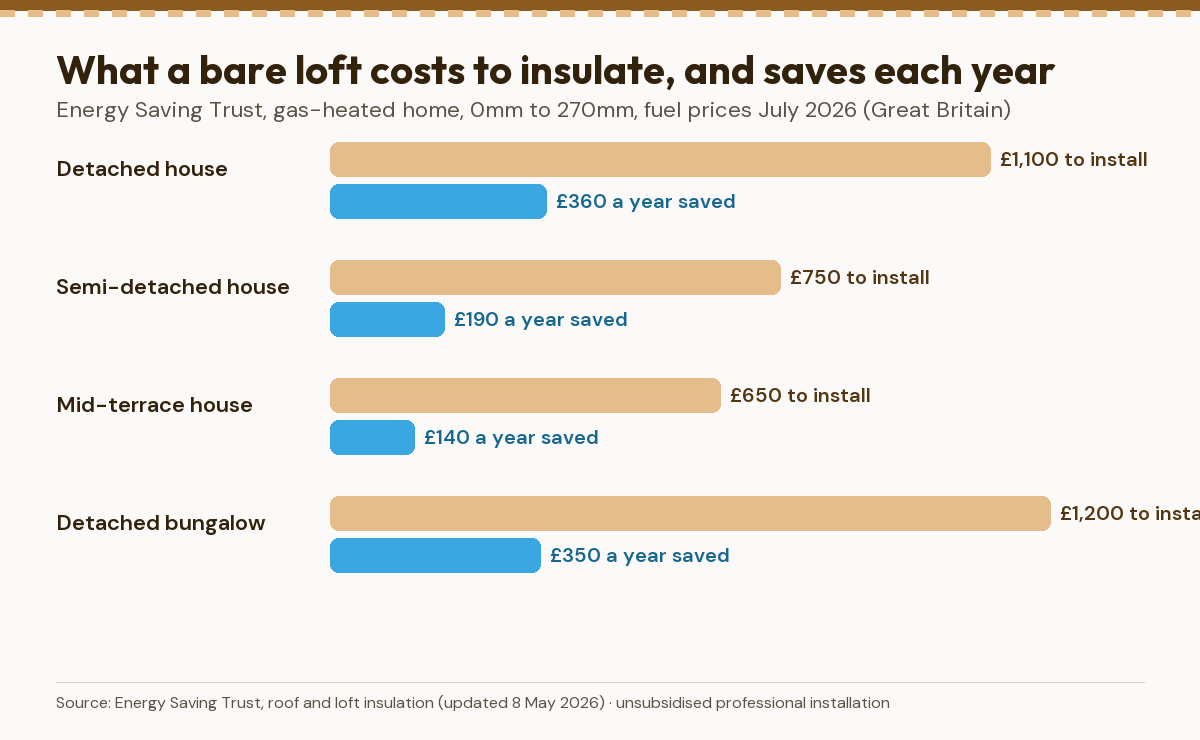
The Energy Saving Trust price table
The Energy Saving Trust (EST) is the independent source most installers and councils quote. Its roof and loft page was last updated on 8 May 2026, and its savings figures use fuel prices from July 2026 for Great Britain and November 2025 for Northern Ireland. All figures assume unsubsidised professional installation, and the EST is clear that prices vary.
| Home (Great Britain, gas) | Bare loft to 270mm | Saving a year | Top-up 120 to 270mm | Top-up saving a year |
|---|---|---|---|---|
| Detached house | £1,100 | £360 | £800 | £35 |
| Semi-detached house | £750 | £190 | £600 | £17 |
| Mid-terrace house | £650 | £140 | £500 | £13 |
| Detached bungalow | £1,200 | £350 | £800 | £35 |
Two things stand out. First, a bungalow costs the most, because the whole footprint of the home sits under the loft. Second, the top-up column shows how little you gain once a decent layer is already in place. A semi-detached house spends about £600 to save an extra £17 or so a year.
Where the saving comes from. Loft insulation does not generate anything: it stops heat you have already paid for escaping. The EST estimates that an uninsulated home loses around 25% of its heat through the roof, and the bill saving is that heat staying in the rooms below. The actual figure depends on your tariff, how warm you keep the house and how you heat it.
Northern Ireland prices
Northern Ireland has its own table because heating oil, not mains gas, is the norm, and installation prices differ.
| Home (Northern Ireland) | Bare loft to 270mm | Saving a year | Top-up 120 to 270mm | Top-up saving a year |
|---|---|---|---|---|
| Detached house | £1,500 | £380 | £950 | £35 |
| Semi-detached house | £1,100 | £230 | £700 | £20 |
| Mid-terrace house | £950 | £210 | £650 | £19 |
| Detached bungalow | £1,700 | £370 | £1,000 | £35 |
If you live in Northern Ireland, check the Affordable Warmth Scheme before you pay: households with gross income under £23,000 can have loft insulation installed or topped up to 300mm.
What pushes a quote up
The EST averages describe a straightforward cold loft: easy access, regular joists, no damp, nothing stored. Real lofts often differ, and each difference has a cost.
- Clearing the loft. Someone has to move decades of boxes. Some installers include it; many charge.
- Removing old insulation. Rarely needed. It is justified if the old material is damp, contaminated or has been disturbed by pests. Ofgem’s ECO4 guidance treats extraction as outside the scheme except in limited repair cases, so expect to pay for it yourself.
- Storage. Keeping a boarded floor means raising it on supports so the full depth fits underneath. See loft boarding and insulation.
- Rooms and flat roofs. Insulating at the rafters or in a loft conversion is specialist work and costs much more; see warm roof vs cold roof.
- Ventilation work. Clearing blocked eaves or adding vents is part of doing the job properly, not an optional extra.
VAT: the one genuine date for people paying
HMRC’s Notice 708/6 zero-rates the installation of energy-saving materials, including insulation, in homes until 31 March 2027. From 1 April 2027 the rate reverts to 5%. The relief applies only when a contractor supplies and installs the insulation; a retailer’s sale of rolls for you to lay yourself is standard-rated. That is a real, dated reason to get a professional job done this winter if you were going to do it anyway. It is not a reason to rush into a job you are unsure about. More detail: VAT on loft insulation.
Ways to pay if no free scheme fits. Pay a contractor outright (0% VAT until 31 March 2027); do it yourself if the loft is dry, easy to reach and not a flat roof; in Scotland, apply to Home Energy Scotland for a loft insulation grant of up to £1,500 (homeowners, no benefit test, and do not start work until the offer is in writing). If an installer offers credit, compare the representative APR and the total repayable against simply saving up: at these prices, a few months of saving usually covers it.
Reading a quote
A good quote names the material (usually mineral wool), the finished depth (270mm is the Energy Saving Trust figure for mineral wool), whether it is laid in two crossed layers, how the eaves will be kept clear, what happens to stored items and the loft hatch, and what guarantee is offered and who backs it. It should also say whether the installer is TrustMark-registered and which Competent Person Scheme they belong to, both of which you can check online. The checklist for choosing an installer covers the questions the EST suggests asking.
Once you have the numbers, the decision is usually easy for a bare loft and much less clear-cut for a top-up. Is loft insulation worth it? works through both.
Before you decide
Why is my quote higher than these figures?
The EST figures are averages for a straightforward loft. Clearing a cluttered loft, removing old or damp insulation, raising boards for storage, awkward access or a room in the roof all add cost. Ask for the quote to be itemised so you can see which of these you are paying for.
Is it cheaper to wait for a grant?
Only if you are likely to qualify. ECO4 ends on 31 December 2026 and the Warm Homes: Local Grant is means-tested. If you do not pass the gates, waiting just means another winter of the saving going through the roof.
Should I buy the cheapest quote?
Not automatically. Check TrustMark registration and ask how ventilation will be handled. A cheap job that blocks the eaves can cause condensation, which costs more to put right than the difference between quotes.
Can I spread the cost?
Some installers offer credit. If they do, they must show you the representative APR and total amount repayable before you sign. In Scotland, Home Energy Scotland offers interest-free loans for some measures alongside its grants.
Questions people ask
How much is loft insulation per m2?
The Energy Saving Trust publishes costs per house type rather than per square metre, because access, clearing and the number of layers matter as much as floor area. Divide a written quote by your loft floor area if you want to compare installers like for like.
Is there VAT on loft insulation?
Installed by a contractor in a home, it is zero-rated until 31 March 2027 and reverts to 5% from 1 April 2027 (HMRC Notice 708/6). Materials you buy to fit yourself are standard-rated.
How long does loft insulation take to pay for itself?
On the EST figures, a bare loft pays back in roughly three to five years depending on house type. A top-up from 120mm can take over 20 years, and more than 35 years for a semi-detached house.
Does loft insulation cost more in Northern Ireland?
Yes. The EST puts a bare loft at £950 to £1,700 in Northern Ireland, with savings of £210 to £380 a year at November 2025 fuel prices, because most homes there heat with oil.
Is DIY loft insulation cheaper?
You save the labour, but materials bought for DIY carry standard-rate VAT and the job is only suitable for a dry, easy-to-reach loft that is not a flat roof.
Sources we checked
- Energy Saving Trust, Roof and loft insulation (last updated 8 May 2026) — read 29 September 2026
- HMRC, VAT on energy-saving materials and heating equipment (Notice 708/6) — read 29 September 2026
- Home Energy Scotland, Grant and Loan — read 29 September 2026
- Ofgem, Energy Company Obligation (ECO) — read 29 September 2026
- GOV.UK, Apply for the Warm Homes: Local Grant to improve a home — read 29 September 2026
Ask for loft insulation quotes or a second opinion
Tell us a little about your situation. We pass your enquiry to relevant independent firms covering your postcode; they contact you directly. There is no charge to you for this.
What happens next
- We read your enquiry and check which kind of firm can help.
- We pass it to relevant independent firms that cover your postcode.
- They contact you with questions or a quote. You compare, and decide — with no obligation to go ahead.