Top-ups
Topping up loft insulation: is it worth it?
For homes that already have some insulation in the loft, which is most of them. This is the page lead-generation sites tend to skip, because the numbers are unexciting. We would rather you knew them before anyone quotes you.
Loft insulation cost and payback estimator
Uses the Energy Saving Trust's published figures (updated 8 May 2026; Great Britain fuel prices July 2026, Northern Ireland November 2025). Unsubsidised professional installation; real quotes vary.
Your indicative result
Simple payback = installed cost divided by the annual bill saving (our arithmetic on the EST figures). If you qualify for a funded scheme your cost may be nothing: check who qualifies.
The top-up numbers
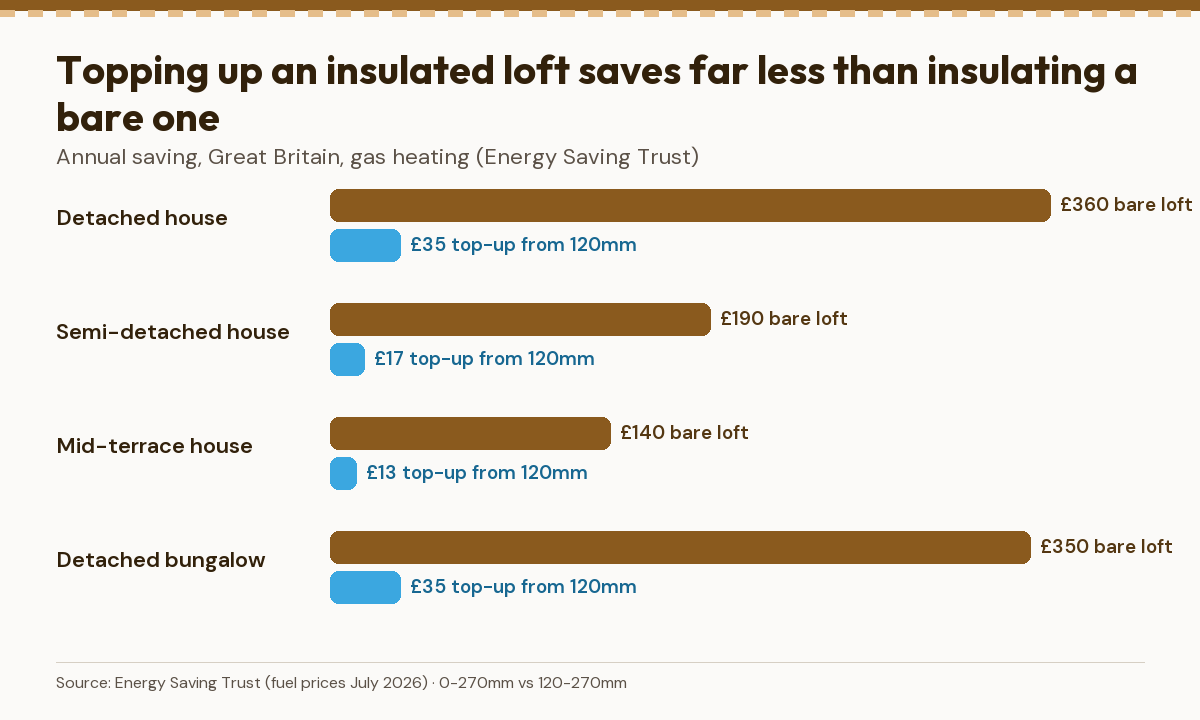
The Energy Saving Trust (EST) publishes separate figures for insulating a bare loft and for topping up one that already has 120mm. They are the clearest illustration we know of why the first layer matters most.
| Home (Great Britain, gas) | Top-up cost, 120 to 270mm | Saving a year | Simple payback | Bare-loft saving, for comparison |
|---|---|---|---|---|
| Detached house | £800 | £35 | about 23 years | £360 |
| Semi-detached house | £600 | £17 | about 35 years | £190 |
| Mid-terrace house | £500 | £13 | about 38 years | £140 |
| Detached bungalow | £800 | £35 | about 23 years | £350 |
Simple payback is our arithmetic: the EST cost divided by the EST annual saving. Loft insulation lasts around 40 years, according to the EST, so a top-up does eventually pay for itself, but slowly. In Northern Ireland the top-up saving is a similar £19 to £35 a year.
Why the first layer does almost all the work
Heat loss through insulation falls steeply with the first few centimetres and then flattens out. Going from nothing to 120mm captures most of the benefit; going from 120mm to 270mm captures what is left. That is physics, not a sales position, and it is why the bare-loft saving is roughly ten times the top-up saving for most house types.
It is also why Ofgem’s ECO4 guidance splits loft insulation into two measures at 100mm of existing insulation. A loft with 100mm or less is the job schemes are designed for. A loft with more counts for far less.
When a top-up is worth doing
- Your layer is 100mm or less. You are closer to the bare-loft figures than the top-up figures, and you may qualify for funded work. Check who qualifies.
- A scheme will pay. If ECO4 or a council scheme offers a top-up as part of a package, there is no reason to refuse it.
- Comfort, not payback. A cold bedroom under the eaves or a top-floor flat can feel noticeably warmer. That is a fair reason to spend a few hundred pounds, as long as you are not expecting it to pay for itself quickly.
- You are doing other loft work anyway. If the loft is being cleared, boarded or rewired, adding a layer at the same time costs little extra.
- You can do it yourself. A DIY top-up with a few rolls costs a fraction of a professional job; see how to insulate a loft. Bought materials are standard-rated for VAT, while professionally installed insulation is zero-rated until 31 March 2027.
When it is not
If you already have 200mm or more, the saving from reaching 270mm is smaller still. Your money will usually go further on draught-proofing the loft hatch, sealing gaps where pipes and cables pass through the ceiling, or looking at walls and windows. If you are being pushed hard to replace sound mineral wool with something else, read our guidance on spray foam first.
A top-up done properly
The new layer goes across the joists, at right angles to the existing one, without squashing either. The eaves stay clear for ventilation. Pipes and cold water tanks in the loft get lagged, because the loft will be colder once more heat stays downstairs. Any stored boxes come off the insulation, or the storage is raised on supports. And the installer tells you, in writing, the depth before and after.
Not a real home. A semi-detached house has about 120mm of old mineral wool, evenly laid and dry. The owners are quoted about £600 for a professional top-up (the EST average). On the EST figures it saves an extra £17 or so a year, a payback of around 35 years. Topping up themselves with rolls from a DIY store costs much less, and they decide the comfort in the back bedroom is worth an afternoon’s work.
For the full payback picture, including bare lofts, see is loft insulation worth it?.
Before you decide
An installer told me I would save hundreds with a top-up.
That is the figure for a bare loft. The Energy Saving Trust's top-up figures from 120mm are £13 to £35 a year. Ask them which starting depth their figure assumes.
My loft has about 50mm. Is that a top-up?
Technically, but it behaves like a thin loft. Under ECO4, 100mm or less counts as the bigger loft measure, and the saving is much closer to the bare-loft figures than the 120mm top-up figures.
Should I pay to remove the old insulation first?
Usually not. Dry, clean insulation can stay and the new layer goes on top. Removal is for damp, contaminated or damaged material, and Ofgem's ECO4 guidance treats extraction as outside the scheme except in limited repair cases.
Questions people ask
Is it worth topping up loft insulation?
Financially, only slowly: the Energy Saving Trust puts a 120mm-to-270mm top-up at £13 to £35 a year for £500 to £800. It is worth it if your layer is 100mm or less, if a scheme pays, or for comfort in a cold top-floor room.
Can I get a free loft insulation top-up?
Sometimes. ECO4 has a loft measure for homes with more than 100mm already, but it counts for much less, so it is a low priority. Lofts with 100mm or less are far more likely to be funded.
How much does a loft insulation top-up cost?
The Energy Saving Trust puts 120mm to 270mm at about £500 (mid-terrace), £600 (semi) and £800 (detached house or bungalow) in Great Britain, unsubsidised.
Can I top up loft insulation myself?
Yes, if the loft is dry, easy to reach and not a flat roof. Lay the new rolls across the joists, at right angles to the existing layer, and keep the eaves clear.
Sources we checked
- Energy Saving Trust, Roof and loft insulation (last updated 8 May 2026) — read 29 September 2026
- Ofgem, ECO4 Guidance: Delivery v4.0 (26 March 2026) — read 29 September 2026
- HMRC, VAT on energy-saving materials and heating equipment (Notice 708/6) — read 29 September 2026
Ask for loft insulation quotes or a second opinion
Tell us a little about your situation. We pass your enquiry to relevant independent firms covering your postcode; they contact you directly. There is no charge to you for this.
What happens next
- We read your enquiry and check which kind of firm can help.
- We pass it to relevant independent firms that cover your postcode.
- They contact you with questions or a quote. You compare, and decide — with no obligation to go ahead.