Council route
LA Flex: free loft insulation without benefits
For owner-occupiers and private tenants who are not on a qualifying benefit but are on a modest income or struggle to keep warm. LA Flex (flexible eligibility) lets your council open ECO4 to you. Here is how the four routes work and what the council actually does.
Which route fits your home? A one-minute check
Five questions, no contact details. The result shows the routes your answers point to; the scheme, council or supplier makes the real decision.
Your indicative result
Indicative only, based on the published rules we read on 29 September 2026. Nothing is sent anywhere. Check your EPC band on the GOV.UK register before you apply.
What LA Flex is for
The standard ECO4 route relies on benefits, and plenty of households who struggle with heating bills do not claim any. Flexible eligibility exists to catch them. Ofgem’s guidance for councils (version 3.0, published 27 March 2026) says it allows local authorities to identify and refer consumers “who own or privately rent their home and are considered fuel poor or vulnerable to the effects of living in a cold home.”
The mechanics matter. Your council does not install anything and does not pay for anything. It checks your circumstances and issues a declaration confirming you are eligible. Suppliers, installers or managing agents use that declaration to take the job forward, decide which measures the home is suitable for, and fund them through ECO4.
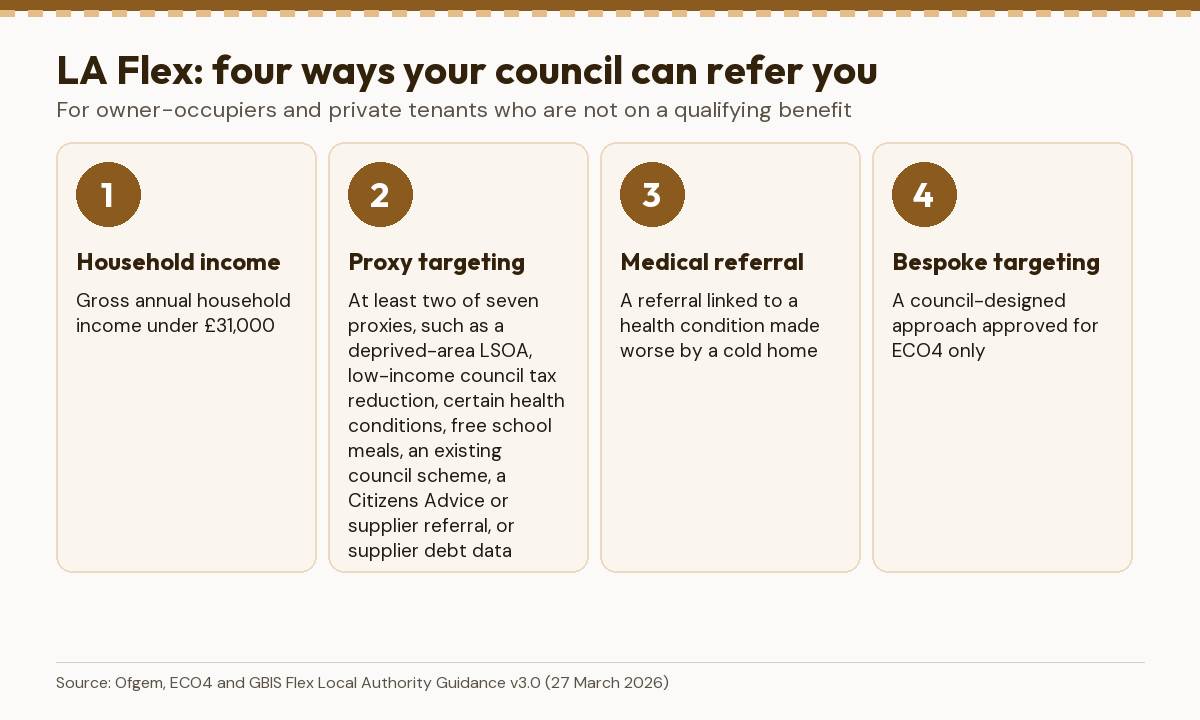
The four routes
| Route | Who it catches | What evidence looks like |
|---|---|---|
| 1. Household income | Combined gross household income under £31,000 | Payslips, pension statements, savings interest for every adult |
| 2. Proxy targeting | Households meeting two of seven proxies | For example a council tax reduction award plus a deprived-area postcode |
| 3. Medical referral | Someone whose health is made worse by a cold home | A referral through the process in Ofgem’s guidance |
| 4. Bespoke targeting | Households found by a council’s own approved method | Set by the council; ECO4 only |
Route 1: household income. Households with a gross annual income of less than £31,000 are eligible. It is the combined income of every adult aged 18 or over who lives in the home permanently, and Ofgem is explicit that lodgers and relatives count. The threshold is the same regardless of the size of the home, how many people live there or where it is. That makes it simple, but harsh on larger households just over the line.
Route 2: proxy targeting. A household meeting at least two of seven proxies qualifies. The proxies are: living in a deprived Lower Layer Super Output Area; receiving a low-income council tax reduction; vulnerability because of certain health conditions; eligibility for free school meals; support from an existing council scheme; a referral from Citizens Advice or an energy supplier; or identification through energy supplier debt data. Some pairings are not allowed: the deprived-area proxy cannot be combined with the health proxy, and supplier debt data cannot be combined with the council scheme or referral proxies.
Route 3: medical referral. For people whose health condition is made worse by living in a cold home, evidenced through the process the guidance sets out.
Route 4: bespoke targeting. An ECO4-only route that lets a council propose its own evidence-based way of finding eligible households, approved in advance.
The home still has to qualify
LA Flex changes who can apply, not which homes can be treated. The ECO4 rules on the property still apply: EPC band D, E, F or G for owner-occupiers; E, F or G for private rented homes, with the landlord’s permission. Ofgem also tells councils to explain that a SAP or RdSAP assessment will be carried out in your home, and that the result can affect eligibility. If your EPC is old, the new assessment may put the home in a different band.
How to use LA Flex
- Check your council takes part. Councils that participate publish an LA Flex statement of intent, usually on their housing or energy pages. Search your council’s website for “ECO4 flexible eligibility” or “statement of intent”.
- Work out your route. Most households use Route 1 on income. If you are over £31,000, look at the proxies and the medical route before assuming you are out.
- Apply through the council or an installer working with it. Some councils run their own application form; others work with named installers or managing agents. Either way, the council must be the one to issue the declaration.
- Assessment and survey. An assessor rates the home and decides which measures fit. The loft, if it has 100mm or less of insulation, is likely to be near the top of the list.
- Install before the end date. Ofgem’s guidance says LA Flex installations for ECO4 must be completed by 31 December 2026.
Not a real household. A retired couple own a mid-terrace house rated EPC E with a thin layer of old insulation in the loft. Neither receives Pension Credit, and their two pensions and some savings interest add up to £27,000 a year. They are outside the ECO4 benefits route, but under £31,000, so a council with a Flex statement of intent can issue a Route 1 declaration. If they paid instead, the Energy Saving Trust puts a bare mid-terrace loft at about £650, saving about £140 a year.
When LA Flex is not the answer
If your council does not take part, if your income is over the cap and no proxy fits, or if ECO4 runs out of time, look at England’s Warm Homes: Local Grant (income usually £36,000 or less, EPC D-G, to 31 March 2028) or your nation’s scheme. Government loft insulation schemes compared lays them all out, and the cost guide covers paying yourself.
Before you decide
Does the council do the work?
No. Under LA Flex the council identifies and refers eligible households by issuing a declaration. Suppliers, installers or managing agents then decide which projects to take forward and install the measures.
Is £31,000 before or after tax?
Before. Ofgem's guidance uses gross annual income, combined across every adult aged 18 or over living in the home permanently, including lodgers and relatives.
My council is not listed as taking part. Can I use another council?
No: LA Flex is run by the council for the area where the home is. If yours has not published a statement of intent, ask whether it plans to, and look at the benefits route or the Warm Homes: Local Grant instead.
Is there anything to pay?
The declaration costs you nothing. The measures are funded through ECO4, where Ofgem notes that some households are asked to contribute, so ask the installer directly before you agree to anything.
Questions people ask
What is LA Flex?
Local Authority Flexible Eligibility: the part of ECO4 that lets councils refer owner-occupiers and private tenants who are fuel poor or vulnerable to a cold home but do not receive a qualifying benefit.
What is the LA Flex income limit?
Under Route 1, combined gross household income under £31,000. Ofgem says this applies irrespective of property size, household composition or region.
What are the LA Flex proxies?
Route 2 needs at least two of seven proxies: living in a deprived Lower Layer Super Output Area, a low-income council tax reduction, certain health conditions, free school meals, support from an existing council scheme, a Citizens Advice or supplier referral, or supplier debt data. Some combinations are not allowed.
Can private tenants use LA Flex?
Yes. LA Flex is for households who own or privately rent their home; the home must meet ECO4's EPC rules (E-G for private rented) and the landlord must agree to the work.
Does LA Flex end with ECO4?
Yes. Ofgem's guidance says installations under LA Flex for ECO4 must be completed by 31 December 2026.
Sources we checked
- Ofgem, ECO4 and GBIS Flex Local Authority Guidance v3.0 (27 March 2026) — read 29 September 2026
- Ofgem, ECO: homeowners and tenants — read 29 September 2026
- Ofgem, Energy Company Obligation (ECO) — read 29 September 2026
- GOV.UK, Help from your energy supplier: the Energy Company Obligation — read 29 September 2026
- GOV.UK, Apply for the Warm Homes: Local Grant to improve a home — read 29 September 2026
Ask for loft insulation quotes or a second opinion
Tell us a little about your situation. We pass your enquiry to relevant independent firms covering your postcode; they contact you directly. There is no charge to you for this.
What happens next
- We read your enquiry and check which kind of firm can help.
- We pass it to relevant independent firms that cover your postcode.
- They contact you with questions or a quote. You compare, and decide — with no obligation to go ahead.