Schemes compared
Government loft insulation schemes: what is open in 2026
There is no single government loft insulation grant. There are several schemes, each with its own gates, run by different bodies in each nation, and one of the best known closed in March 2026. This page puts them side by side, as we read them on 29 September 2026.
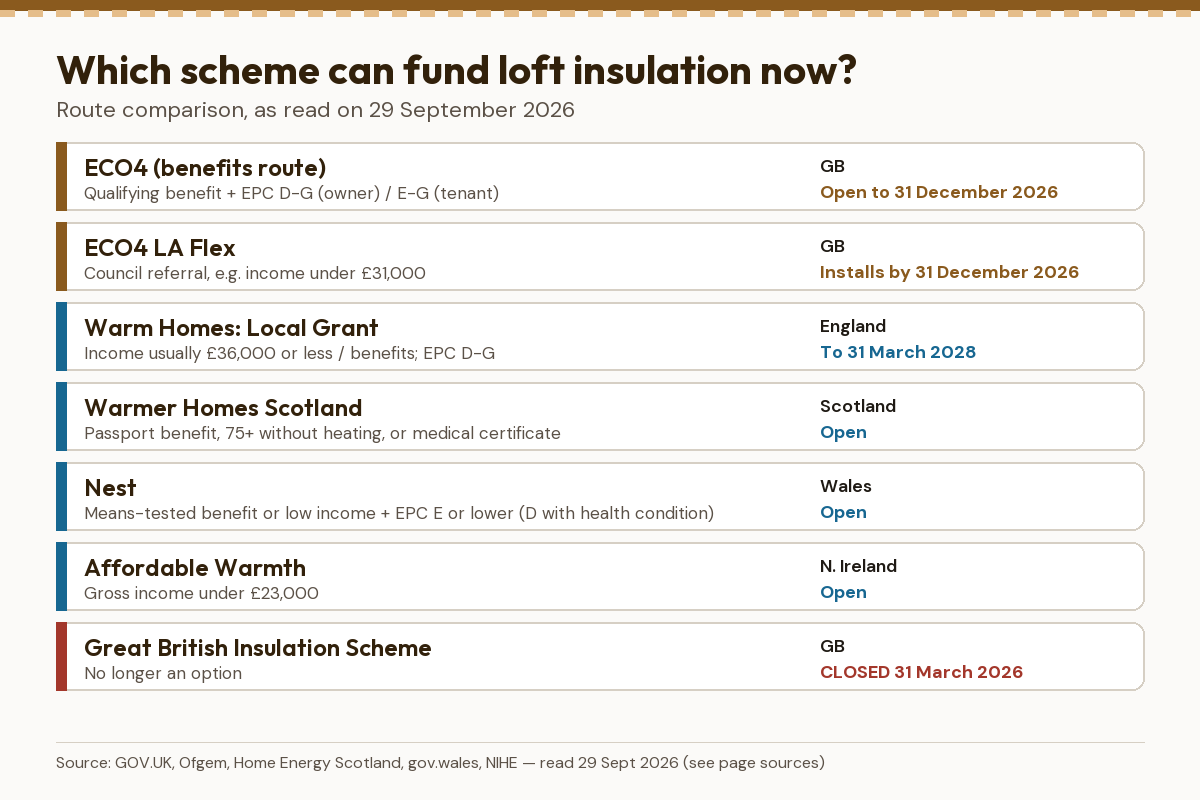
The schemes side by side
| Scheme | Where | Who runs it | Main gates | Status (29 Sept 2026) |
|---|---|---|---|---|
| ECO4 (benefits route) | England, Scotland, Wales | Energy suppliers, regulated by Ofgem | Qualifying benefit; EPC D-G owner, E-G tenant | Open until 31 December 2026 |
| ECO4 LA Flex | England, Scotland, Wales | Your council refers; suppliers fund | Income under £31,000, two proxies, or medical referral | Installs by 31 December 2026 |
| Warm Homes: Local Grant | England | Councils taking part (DESNZ funding) | Income usually £36,000 or less, postcode or benefits; EPC D-G | 1 April 2025 to 31 March 2028 |
| Warmer Homes Scotland | Scotland | Scottish Government via Home Energy Scotland | Passport benefit, 75+ without heating, or medical certificate | Open |
| HES Grant and Loan | Scotland | Home Energy Scotland | Homeowners; no benefit test; loft grant up to £1,500 | Open, first come, first served |
| Nest | Wales | Welsh Government | Means-tested benefit or low income; EPC E or lower (D with a health condition) | Open |
| Affordable Warmth | Northern Ireland | NI Housing Executive | Gross household income under £23,000 | Open |
| Great British Insulation Scheme | Great Britain | Energy suppliers | Was: EPC D-G and council tax band | Closed 31 March 2026 |
ECO4: the supplier obligation
The Energy Company Obligation places a legal duty on medium and large energy suppliers to fund energy-saving work in lower-income and vulnerable households. ECO4 is its fourth phase. Ofgem says it runs until 31 December 2026 following a nine-month extension, and suppliers must complete their obligations by then. It funds insulation, including lofts, and heating upgrades.
For private housing, GOV.UK lists the qualifying benefits and the EPC rules (D to G for owners, E to G for private tenants with the owner’s permission). ECO4 is fabric-first: in a poorly rated home, the roof and walls must be insulated before a new heating system can be funded, which is why so many ECO4 packages start in the loft. Full detail: ECO4 loft insulation.
LA Flex: councils opening the door wider
Flexible eligibility lets councils refer households who are not on a qualifying benefit but are on a low income or vulnerable to a cold home. Ofgem’s guidance sets four routes, and Route 1 is a combined gross household income under £31,000. Your council must have published a statement of intent to take part. See LA Flex loft insulation.
The Warm Homes: Local Grant (England)
This is government-funded, not supplier-funded, and delivered by councils. GOV.UK says household income must usually be £36,000 a year or less (or you may qualify through your postcode or benefits), the home must be in England, privately owned and rated EPC D to G, and loft insulation is among the improvements. Crucially, GOV.UK says your council “will then organise and pay for any improvement work they’ve agreed with you. You will not need to pay for it.” The scheme window runs from 1 April 2025 to 31 March 2028, and your council must be taking part.
Scotland, Wales and Northern Ireland
Each nation runs its own programme, and they are often more generous than people expect.
- Scotland: Warmer Homes Scotland offers support worth £10,000 or more, and “in most cases, the Scottish Government will meet all the costs”. The Home Energy Scotland Grant and Loan adds a loft insulation grant of up to £1,500 for homeowners with no benefit test. Scotland routes.
- Wales: Nest provides free improvements to owners and private tenants who meet its benefit or income-after-housing-costs test in homes rated EPC E or lower. Wales routes.
- Northern Ireland: ECO4 does not apply. The Affordable Warmth Scheme helps households with gross income under £23,000, with loft insulation installed or topped up to 300mm. Northern Ireland routes.
The Great British Insulation Scheme: closed
GBIS ran from 25 July 2023 to 31 March 2026. Its appeal was the “general group”: homes in EPC bands D to G in lower council tax bands qualified without a means test, usually for a single measure such as loft or cavity wall insulation. GOV.UK’s page now says the eligibility service has closed and that installations had to be complete by 31 March 2026. If a site or caller invites you to apply for GBIS, the information is out of date.
What the Warm Homes Plan changes
The Warm Homes Plan, published in January 2026 and updated on 18 March 2026, commits about £15 billion to upgrade up to 5 million homes by 2030. It says the Energy Company Obligation “will be coming to an end”, and it puts over £5 billion into low-income support, delivered first through the Warm Homes: Local Grant and Social Housing Fund and then consolidated into a single scheme with area-based delivery from 2027/28. It also plans low and zero-interest loans for homeowners, with details to follow. Our guide to loft insulation after ECO4 tracks this.
Choosing your door
If you are on a qualifying benefit in Great Britain, ECO4 is the obvious first call, while it lasts. If you are not, ask your council about LA Flex and, in England, the Warm Homes: Local Grant. In Scotland, Wales and Northern Ireland, start with your nation’s scheme. Not sure? The one-minute checker on who qualifies points you to the right one, and the cost guide tells you what it costs if none fits.
Before you decide
Is ECO4 really a government scheme?
It is a government-set obligation, regulated by Ofgem, but the money comes from energy suppliers. Ofgem describes ECO as not a grant scheme, which is why offers differ between suppliers and why you may be asked to contribute.
Why do so many sites still talk about the Great British Insulation Scheme?
Because it was the one route that qualified homes by council tax band without a means test, and old pages have not been updated. It ended on 31 March 2026. GOV.UK's eligibility service now shows a closure notice.
Is there anything for people who are not on a low income?
Not a free scheme. The Warm Homes Plan promises low and zero-interest loans for homeowners regardless of income, but the details have not been set out yet. In Scotland, homeowners can apply for a Home Energy Scotland loft grant of up to £1,500 without a benefit test.
Questions people ask
What replaced the Great British Insulation Scheme?
Nothing replaced it directly. The Warm Homes Plan routes low-income support through the Warm Homes: Local Grant and Social Housing Fund, merging into a single low-income scheme from 2027/28, and ECO4 continues until 31 December 2026.
Is ECO4 still open?
Yes, until 31 December 2026 after a nine-month extension. Work has to be installed by then, so capacity in the final months is limited, and Ofgem notes some households are asked to contribute.
Is the Warm Homes: Local Grant available everywhere in England?
Only where your council is taking part. GOV.UK's online checker tells you, and your council organises and pays for the agreed work.
Does ECO4 apply in Northern Ireland?
No. ECO4 is administered by Ofgem for Great Britain. Northern Ireland's routes are the Housing Executive's Affordable Warmth Scheme and NISEP grants.
Is there a government loft insulation grant for everyone?
No. Every free route in 2026 is means-tested or targeted. If you do not pass a scheme's gates you pay, which is why we publish the Energy Saving Trust cost figures alongside the schemes.
Sources we checked
- GOV.UK, Help from your energy supplier: the Energy Company Obligation — read 29 September 2026
- Ofgem, Energy Company Obligation (ECO) — read 29 September 2026
- Ofgem, ECO: homeowners and tenants — read 29 September 2026
- Ofgem, ECO4 and GBIS Flex Local Authority Guidance v3.0 (27 March 2026) — read 29 September 2026
- GOV.UK, Great British Insulation Scheme (closure notice) — read 29 September 2026
- GOV.UK, Apply for the Warm Homes: Local Grant to improve a home — read 29 September 2026
- DESNZ, Warm Homes: Local Grant policy guidance (June 2026 update) — read 28 September 2026
- DESNZ, Warm Homes Plan (published 21 January 2026, updated 18 March 2026) — read 29 September 2026
- Home Energy Scotland, Warmer Homes Scotland — read 29 September 2026
- Home Energy Scotland, Grant and Loan — read 29 September 2026
- Welsh Government, Nest: eligibility for free home energy efficiency improvements — read 29 September 2026
- Northern Ireland Housing Executive, Affordable Warmth Scheme — read 29 September 2026
- nidirect, Energy saving grants in your area — read 29 September 2026
Ask for loft insulation quotes or a second opinion
Tell us a little about your situation. We pass your enquiry to relevant independent firms covering your postcode; they contact you directly. There is no charge to you for this.
What happens next
- We read your enquiry and check which kind of firm can help.
- We pass it to relevant independent firms that cover your postcode.
- They contact you with questions or a quote. You compare, and decide — with no obligation to go ahead.