Roof types
Cold roof vs warm roof: where should loft insulation go?
For homeowners deciding between insulating the loft floor and insulating the roof itself, and for anyone with a loft conversion or rooms in the roof. The choice changes the cost, the efficiency and whether funded schemes will treat it as a simple loft job.
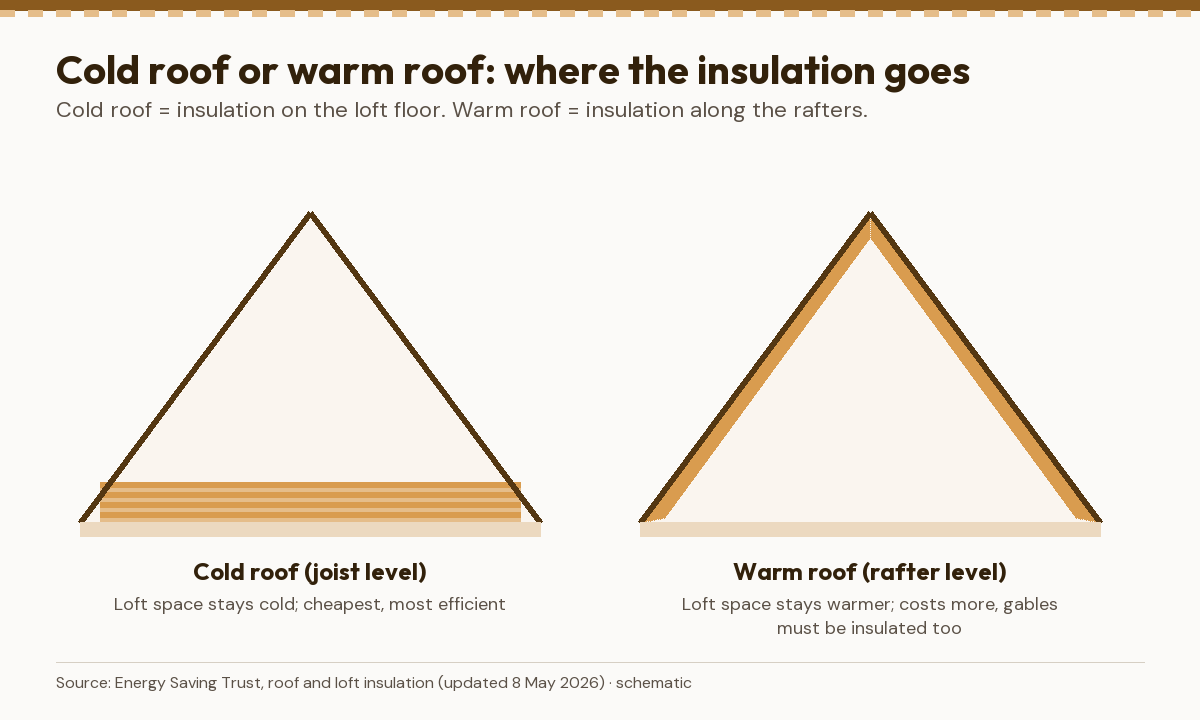
Cold roof: insulating the loft floor
This is what most people mean by loft insulation. Mineral wool goes between the joists and a second layer across them, to 270mm, and the roof space above stays cold and ventilated. The Energy Saving Trust (EST) describes it as the easiest loft to insulate if access is good and there is no damp, and as something many people can do themselves. It is also more efficient than insulating the roof, because you are not heating the air in the loft before it reaches the insulation.
The consequences of a cold loft are practical rather than serious: water tanks and pipes up there need lagging so they do not freeze, and storage needs a raised floor so the insulation is not squashed.
Warm roof: insulating the rafters
The alternative is fitting rigid insulation boards between and over the sloping rafters. The EST sets out the trade-off clearly:
| Cold roof (joist level) | Warm roof (rafter level) | |
|---|---|---|
| Loft space | Cold | Warmer; tanks and pipes less exposed to frost |
| Cost | Standard loft insulation prices | Much more expensive |
| Efficiency | More efficient | Less efficient: you heat the loft air too |
| Other work | Keep eaves clear; lag pipes | Gable walls, party walls and chimneys in the loft must also be insulated |
| Storage | Raised boards over full-depth insulation | Loft floor can be boarded freely |
| DIY? | Often yes, in a dry, accessible loft | No: professional installation |
The EST’s warning about the “other work” row is worth repeating: if the gable walls, party walls and chimneys in the loft are left uninsulated, heat bypasses the new rafter insulation and it underperforms.
Room-in-roof and loft conversions
Rooms with sloping ceilings can be insulated, which keeps heat in during winter and stops them overheating in summer. The EST says this is a job for trained installers, who often remove plasterboard to fit insulation between and over the rafters and on any vertical walls. Flat sections of ceiling can take ordinary rolls, and dormer windows need insulating and ventilating too.
For the funded schemes, room-in-roof is its own category. Ofgem’s ECO4 guidance lists roof insulation as flat roof, pitched roof and room-in-roof, and requires the roof to be insulated before poorly rated homes can receive heating measures. In Scotland, the Home Energy Scotland Grant and Loan offers up to £3,000 for flat-roof or room-in-roof insulation, twice the loft grant.
Flat roofs
A flat roof has no loft to lay insulation in. The EST says flat roofs need professional installation, and the work is done from above or below by a specialist. They are outside the simple cold-loft job that most “free loft insulation” offers describe.
Where spray foam fits
Spray foam is one way of insulating at rafter level, and the EST describes closed-cell foam sprayed under an old, poorly maintained roof as one of the highest-risk insulation options. If a warm roof is what you need, rigid boards fitted by a competent installer, with the roof checked and ventilation planned, are the conventional route. Read spray foam insulation problems before agreeing to foam.
Which should you choose?
If you do not use the loft as a room and can reach it, a cold roof is cheaper, more efficient and simpler, and it is what the schemes and the EST figures assume. If you need a warm roof space, or the loft is already a room, budget for specialist work and ask about room-in-roof funding first. Either way, the ventilation guide explains how to keep the roof timbers dry.
Before you decide
Why would anyone choose a warm roof if it is less efficient?
Because they use the space. If the loft is a room, a store that must stay above freezing, or contains tanks and pipes that are hard to protect, insulating at the rafters keeps it warmer. It is a practical choice, not an efficiency one.
Can I have storage and a cold roof?
Yes. Raise the boarded floor on supports so the full depth of insulation fits beneath, and leave a small air gap under the boards. See our boarding guide.
Will a scheme fund room-in-roof insulation?
ECO4 lists room-in-roof among its roof insulation measures, and Home Energy Scotland offers a higher grant (up to £3,000) for flat roof or room-in-roof insulation. Expect a more detailed assessment than for a simple loft.
Questions people ask
What is the difference between a warm roof and a cold roof?
In a cold roof the insulation sits on the loft floor, so the loft space stays cold. In a warm roof the insulation runs along the rafters, so the roof space stays warmer.
Which is cheaper, a warm roof or a cold roof?
A cold roof. The Energy Saving Trust says insulating at rafter level is much more expensive than most standard loft insulation, partly because gable walls, party walls and chimneys in the loft also need insulating.
How is room-in-roof insulation done?
Trained installers usually fit insulation between and over the rafters and on any vertical walls, often removing plasterboard to do it; flat ceilings can take rolls of loft insulation, and dormers need insulating and ventilating too.
Can I insulate the rafters myself?
The Energy Saving Trust says insulating at the sloping roof, or a flat roof, needs professional installation.
Sources we checked
- Energy Saving Trust, Roof and loft insulation (last updated 8 May 2026) — read 29 September 2026
- Energy Saving Trust, Spray foam insulation: get the facts (last updated 5 December 2024) — read 29 September 2026
- Ofgem, ECO4 Guidance: Delivery v4.0 (26 March 2026) — read 29 September 2026
- Home Energy Scotland, Grant and Loan — read 29 September 2026
Ask for loft insulation quotes or a second opinion
Tell us a little about your situation. We pass your enquiry to relevant independent firms covering your postcode; they contact you directly. There is no charge to you for this.
What happens next
- We read your enquiry and check which kind of firm can help.
- We pass it to relevant independent firms that cover your postcode.
- They contact you with questions or a quote. You compare, and decide — with no obligation to go ahead.