Storage
Loft boarding and insulation: keeping both
For anyone who wants to store things in the loft without wrecking the insulation. Boards laid straight onto the joists over a thick layer squash it, and squashed insulation does not work. The fix is simple, and the Energy Saving Trust describes it.
The problem with boards on joists
In a typical loft, the joists are much shallower than the 270mm of mineral wool the Energy Saving Trust (EST) recommends. If you fill the gaps between the joists and screw boards straight onto them, you can only have as much insulation as the joists are deep. The EST says that insulation between the joists alone may not meet modern recommended levels. Add a second layer and then press boards down on it, and you squash it, and the EST is clear that compressing mineral wool reduces its effectiveness.
A loft boarded straight onto the joists has exactly this problem: a thin layer under the boards, and a thicker layer elsewhere.
The EST’s method: raise the floor
The EST describes the fix in four steps:
- Insulate between the joists as normal.
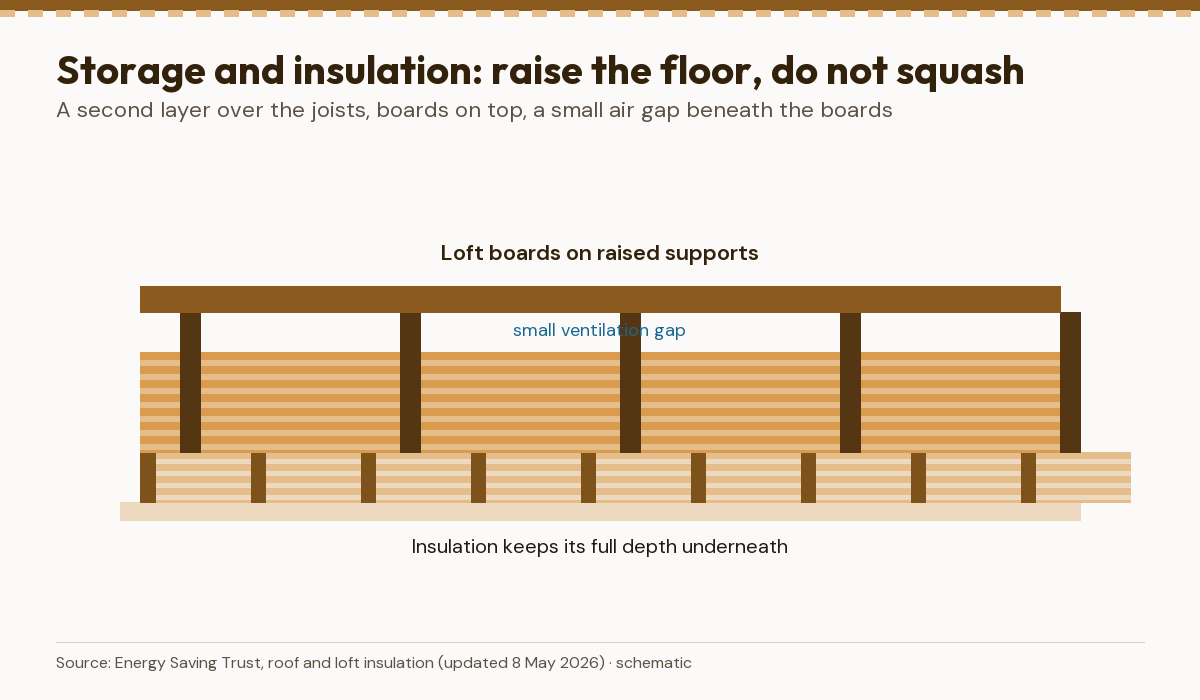
- Raise the floor slightly, using supports fixed to the joists, so the new floor sits above the height of the full insulation.
- Add a second layer across the tops of the joists, underneath where the raised floor will go.
- Fit the boards on the supports, leaving a small gap between the insulation and the underside of the boards for ventilation, to prevent condensation.
The result is a storage platform with full-depth insulation beneath it, and an air gap that lets moisture escape.
| Approach | Insulation under storage | Condensation risk | Verdict |
|---|---|---|---|
| Boards straight onto joists, one layer | Only as deep as the joists | Moderate | Falls short of recommended levels |
| Boards pressed onto a full layer | Squashed | Higher (no air gap) | Loses effectiveness |
| Raised boards over full depth, air gap | Full depth | Lower | The EST’s recommended method |
Planning the storage area
Board only what you need. Most people use the area within reach of the hatch, and the rest of the loft is rarely visited. A smaller platform costs less, keeps more of the loft at full depth, and leaves the eaves clear. Keep heavy items near the walls or over supports, and do not store anything on the unboarded insulation, which flattens it just as boards do.
Check the loft can take the weight before you add storage. If in doubt, ask a builder or surveyor.
Boards, schemes and funded installers
If your loft is being insulated through a scheme, boarded areas need a conversation before the visit. Ofgem’s ECO4 guidance records the existing insulation in a pre-existing loft declaration, and insulation hidden under old boards may not be visible to the assessor. Decide whether the old boards will be lifted, whether the installer will relay them, and whether raising the floor is included. A funded job may insulate the open areas and leave boarded areas as they are, which may be fine for a small platform and less fine for a fully boarded loft.
Not a real home. A family’s loft is fully boarded straight onto the joists over old thin insulation, and they want to keep a storage area. They lift the boards beyond the hatch area, which the installer insulates to full depth, and rebuild a small raised platform by the hatch with a second layer beneath and an air gap. They keep the storage they use, and most of the loft is now at the recommended depth.
Doing it yourself
A raised storage platform is within reach of a competent DIYer in a dry loft. Loft-leg supports and boards are widely sold, and mineral wool rolls are standard DIY stock; bought materials carry standard-rate VAT, while insulation installed by a contractor is zero-rated until 31 March 2027. Our DIY guide covers laying the layers, and loft ventilation explains why the air gap and the eaves matter.
Before you decide
Can I just lay boards on top of the insulation?
Not on a full 270mm layer. Boards laid directly on the joists compress everything above joist height, and the EST warns that squashing mineral wool reduces how well it insulates.
Do I need to board the whole loft?
No. Board only the area you actually use for storage, usually near the hatch, and leave the rest at full depth. It is cheaper and keeps more of the loft properly insulated.
Will a free scheme remove my existing boards?
Do not assume so. Ask the installer before the visit. Moving boards to insulate beneath them, and relaying them, is extra work that may not be included.
Questions people ask
Can you put loft boards over insulation?
Yes, if the boards are raised above the joists on supports so the insulation keeps its depth underneath, with a small gap for ventilation between the insulation and the boards.
Does boarding a loft reduce insulation?
It does if the boards squash the insulation. Insulation only between the joists with boards on top may also fall short of modern recommended levels, according to the Energy Saving Trust.
Why leave a gap under loft boards?
The Energy Saving Trust says to leave a small gap for ventilation between the insulation and the boards to prevent condensation.
How much of the loft should I board?
Only what you need for storage. Leaving the rest at full depth keeps more of the loft insulated and costs less.
Sources we checked
- Energy Saving Trust, Roof and loft insulation (last updated 8 May 2026) — read 29 September 2026
- Ofgem, ECO4 Guidance: Delivery v4.0 (26 March 2026) — read 29 September 2026
Ask for loft insulation quotes or a second opinion
Tell us a little about your situation. We pass your enquiry to relevant independent firms covering your postcode; they contact you directly. There is no charge to you for this.
What happens next
- We read your enquiry and check which kind of firm can help.
- We pass it to relevant independent firms that cover your postcode.
- They contact you with questions or a quote. You compare, and decide — with no obligation to go ahead.